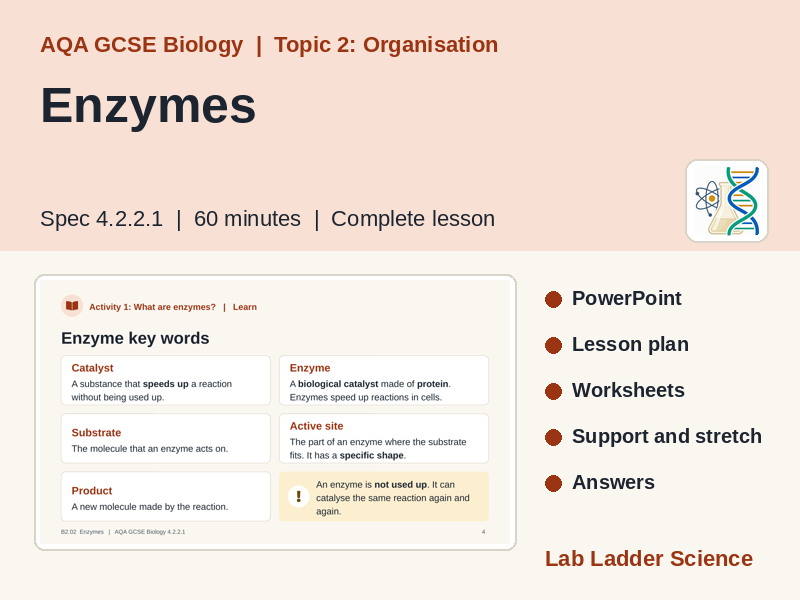
Enzymes lesson for AQA GCSE Biology: lock and key model, denaturing, temperature and pH, and rate calculations. PowerPoint, worksheets and answers.
What is this resource?
This is a complete lesson on enzymes for AQA GCSE Biology (8461), covering the properties of enzymes in specification point 4.2.2.1. It is the second lesson in Topic 2: Organisation and is designed to last 60 minutes.
Students define catalyst and enzyme, use the lock and key model to explain how enzymes work and why they are specific, and use collisions and the shape of the active site to explain how temperature and pH affect enzyme activity, including denaturing. They then calculate rates of reaction from an investigation into catalase in potato, which prepares them for the required practical on the effect of pH on amylase.
What’s included
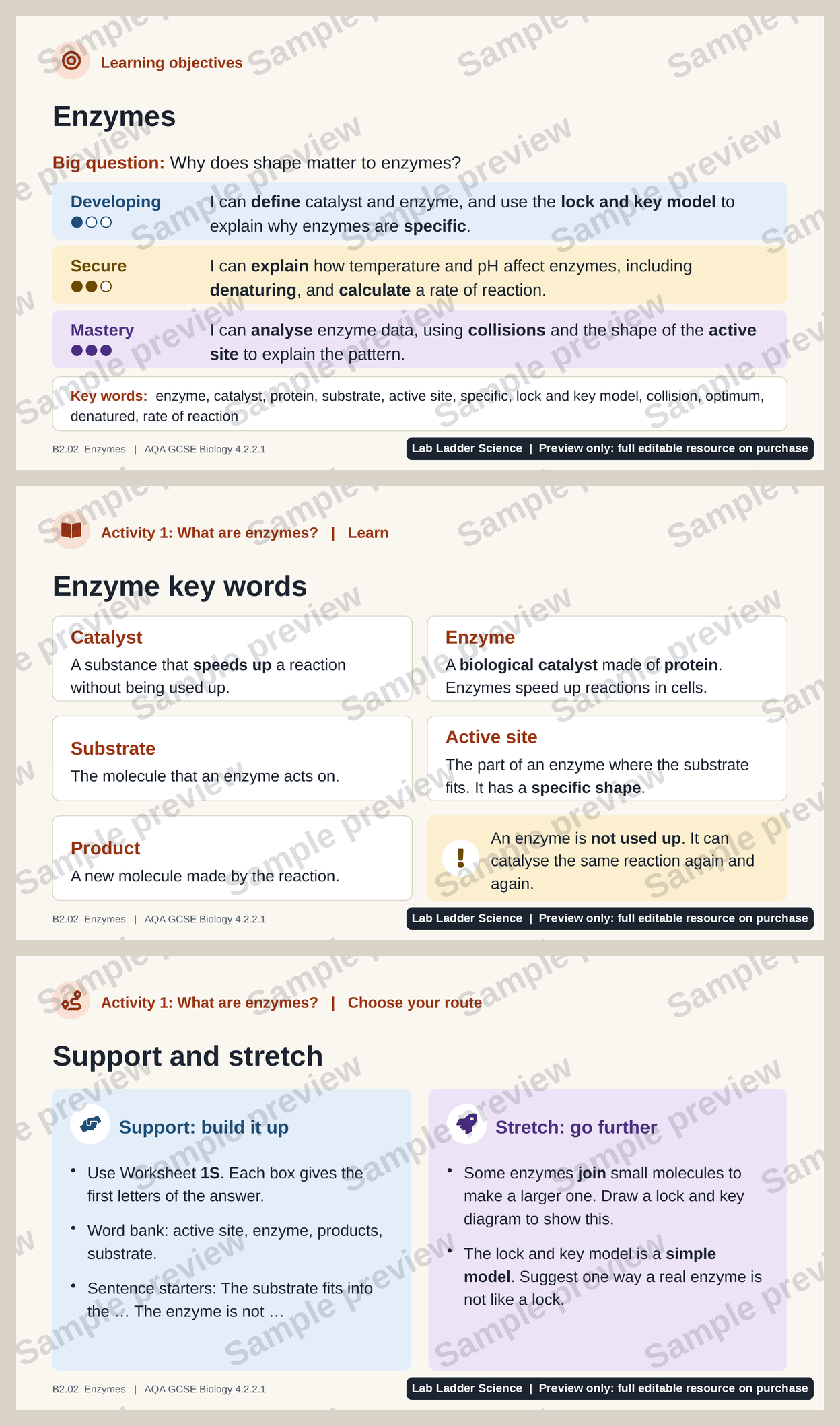
• PowerPoint lesson (32 slides) with full teacher notes on every slide: timings, answers, misconceptions, questioning prompts and optional catalase demos with safety notes.
• Starter on screen as students arrive, based on a real-world hook: Taq, an enzyme from hot spring bacteria that still works at 95 °C.
• Learning objectives at three levels of challenge: Developing, Secure and Mastery.
• Three learning activities, each with a core task, a support option, a stretch task and a ‘stand back’ mini-whiteboard check with answers.
• Plenary exit ticket with one question per level, an answers slide for self-assessment and a return to the starter.
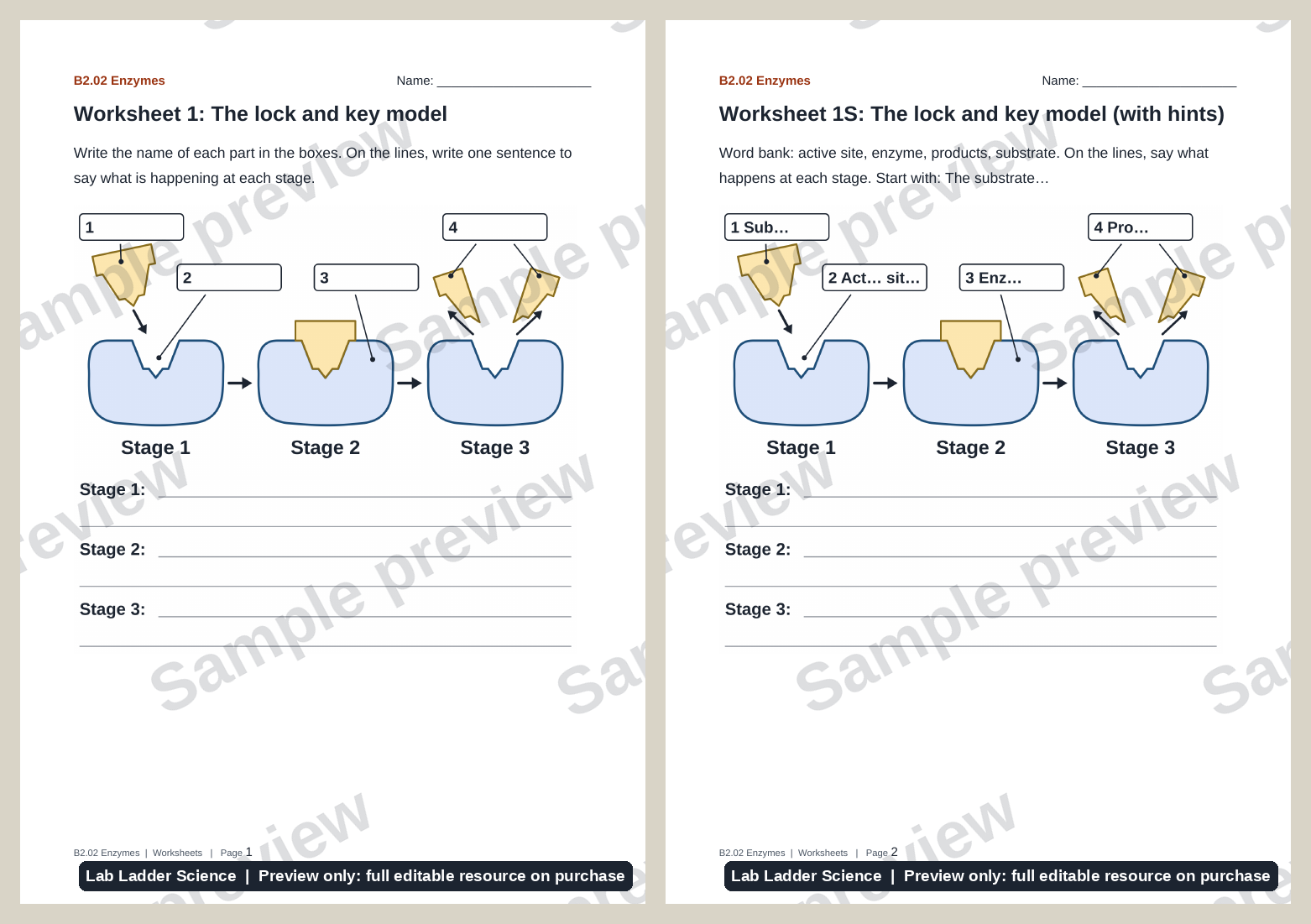
• Clear original diagrams: the lock and key model, sketch graphs of the effects of temperature and pH, a denatured enzyme, and apparatus for measuring the rate of the catalase reaction.
• Editable Word worksheets: label the lock and key model (core and support versions), a card sort to explain enzyme graphs, a rate calculation table, and exam-style questions on the results (core and support versions).
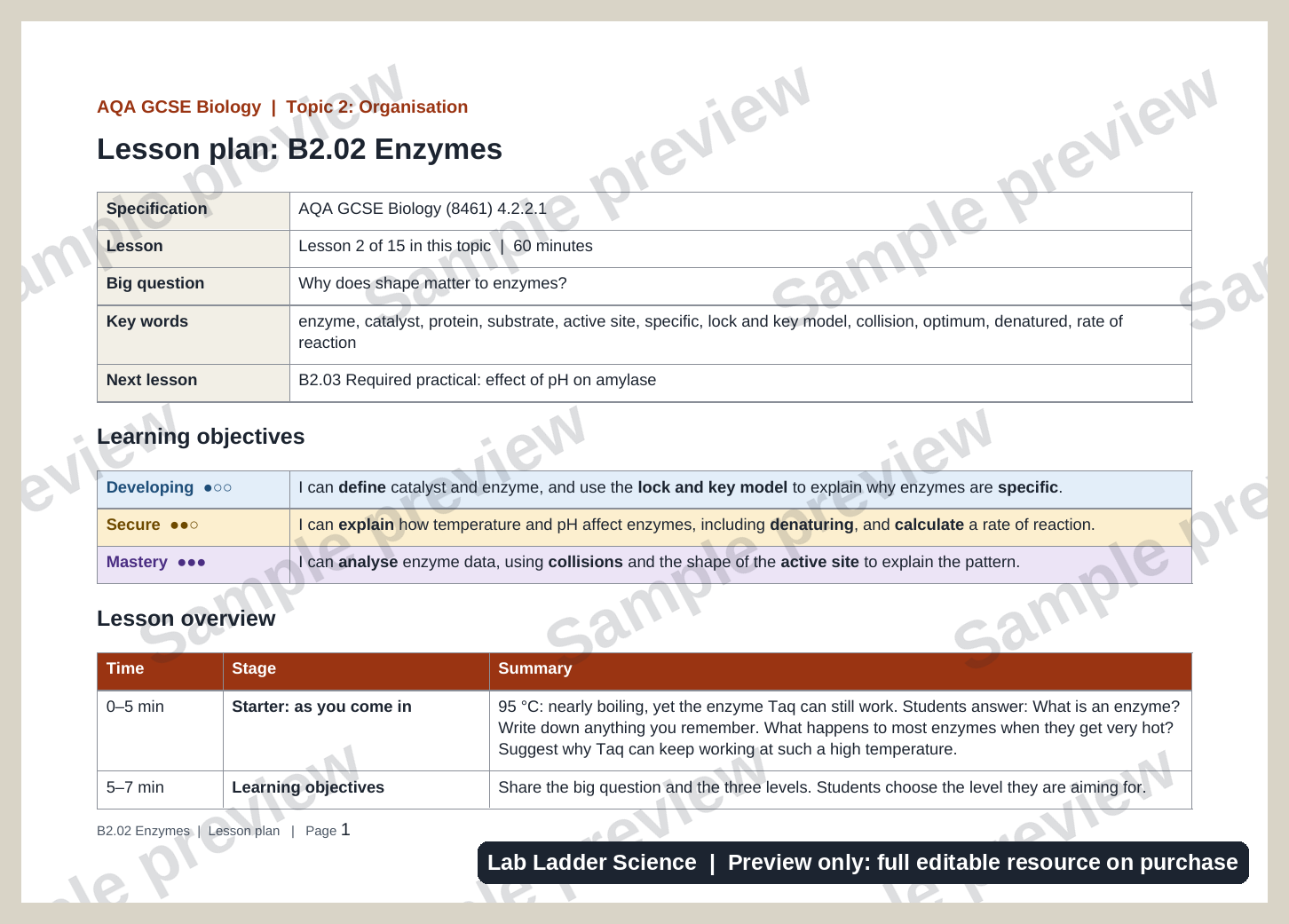
• Word lesson plan with objectives, lesson sequence, differentiation, answers and common misconceptions.
Lesson outline
• Starter (5 min): How can an enzyme keep working at 95 °C?
• Activity 1 (15 min): Enzyme key words and the lock and key model, then label and explain the model.
• Activity 2 (15 min): The effects of temperature and pH, the optimum and denaturing, with a card sort to explain the graphs.
• Activity 3 (15 min): Measuring the rate of the catalase reaction, calculating rates and explaining the results.
• Plenary (8 min): Exit ticket at three levels, then self-assessment against the objectives.
Differentiation and inclusion
Every activity offers support and stretch that all students can choose, so no one is singled out. Support includes first-letter label hints, word banks, sentence starters, clue words and a questions sheet with hints. Stretch tasks ask students to model enzymes that join molecules, find the limits of the lock and key model, explain why Taq works slowly at body temperature, and plan a more precise way to find an optimum temperature.
The slides follow the British Dyslexia Association Style Guide: a clear sans serif font at a large size, a soft cream background, bold (not italics) for emphasis, left-aligned text and plain English. Levels of challenge never rely on colour alone, graphs use labels and marker shapes as well as colour, every slide has a proper title for screen readers, and diagrams include alt text.
How you could use it
• Teach it as the enzymes lesson before the amylase required practical, for Year 9 or Year 10.
• Use it as a ready-made cover lesson: the teacher notes explain every step, and the demos are optional.
• Use the stand back quizzes, exit ticket and questions for retrieval practice before mocks.
• Use the worksheets on their own for homework or revision.
Specification coverage
AQA GCSE Biology 8461, section 4.2.2.1 The human digestive system: enzymes catalyse specific reactions due to the shape of their active site, the lock and key theory as a simplified model, the nature of enzyme molecules and how their activity relates to temperature and pH, and rate calculations (MS 1a, 1c). Collision theory is used to explain the effect of temperature, as in the AQA scheme of work. Key words: enzyme, biological catalyst, protein, substrate, active site, product, specific, lock and key model, optimum, denatured, collision, rate of reaction, catalase. The previous lesson in the series is B2.01 Levels of organisation and the digestive system, and the next is B2.03 Required practical: effect of pH on amylase.
You must log in and be a buyer of this download to submit a review.