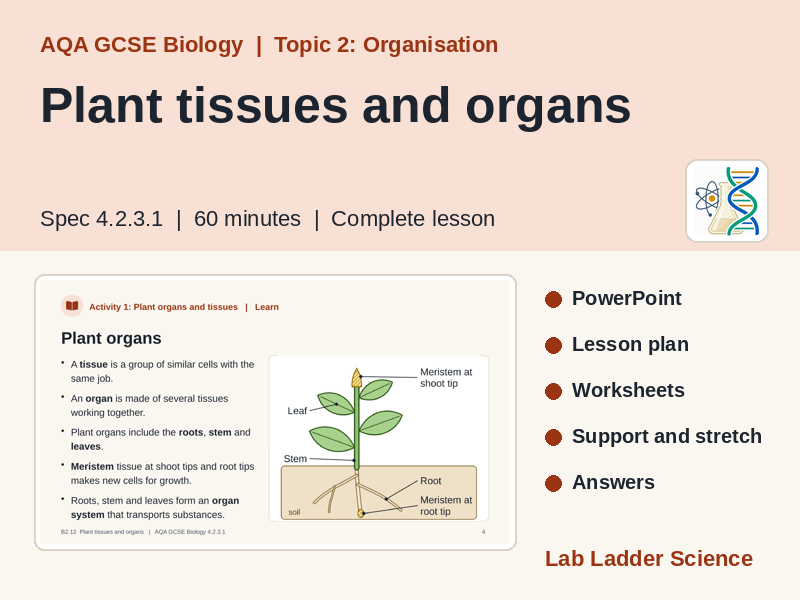
Plant tissues and organs lesson for AQA GCSE Biology 4.2.3.1: leaf structure, stomata, guard cells, stomatal density, worksheets and answers.
What is this resource?
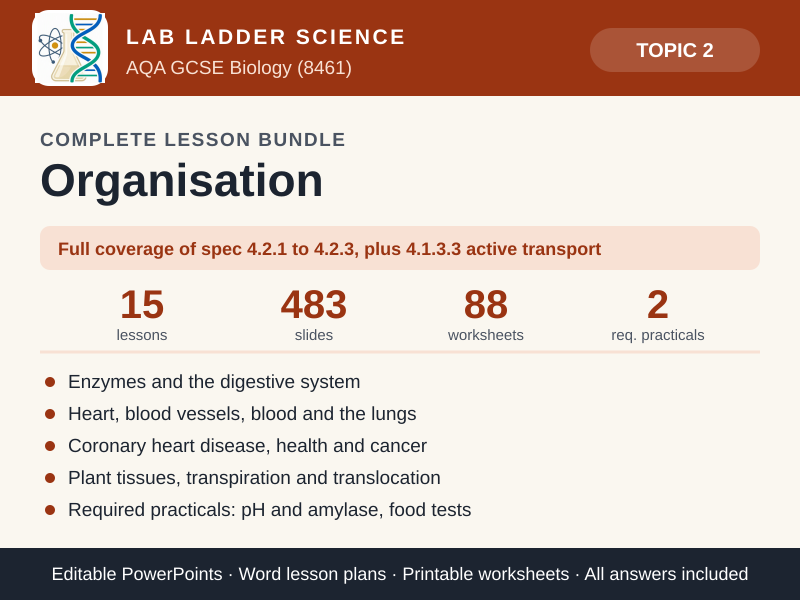
This is a complete lesson on plant tissues and organs for AQA GCSE Biology (8461), covering specification point 4.2.3.1 and the role of stomata and guard cells from 4.2.3.2. It is lesson 12 of 14 in Topic 2: Organisation and is designed to last 60 minutes.
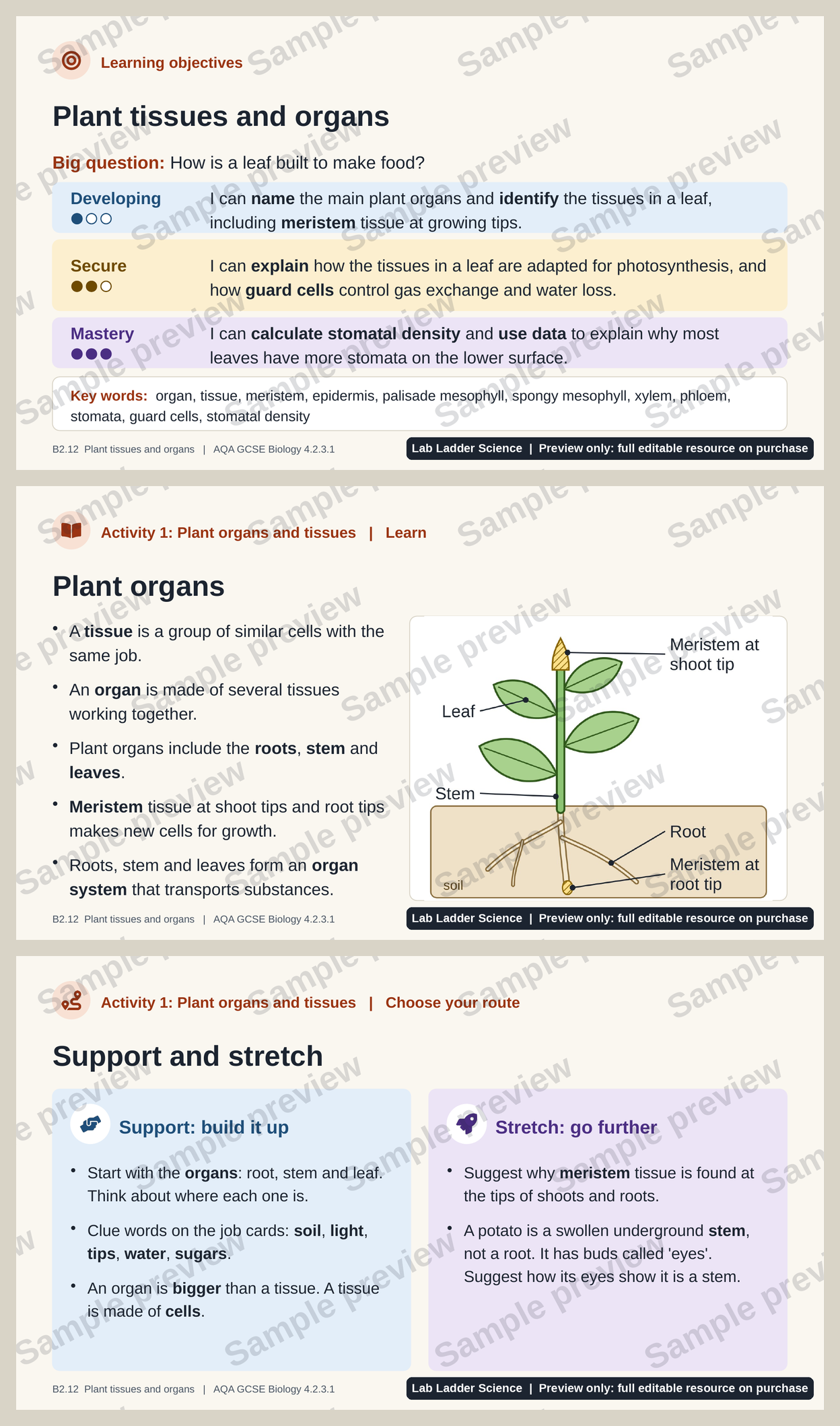
Students learn that roots, stems and leaves are plant organs made of tissues, and that meristem tissue at shoot and root tips makes new cells. They label a leaf cross-section, explain how the epidermis, palisade mesophyll, spongy mesophyll, xylem and phloem are adapted for photosynthesis, and find out how guard cells control gas exchange and water loss. They finish by calculating stomatal density from data and explaining why most leaves have more stomata on the lower surface.
What’s included
• PowerPoint lesson (31 slides) with full teacher notes on every slide: timings, answers, misconceptions, questioning prompts and a balloon model demonstration of guard cells.
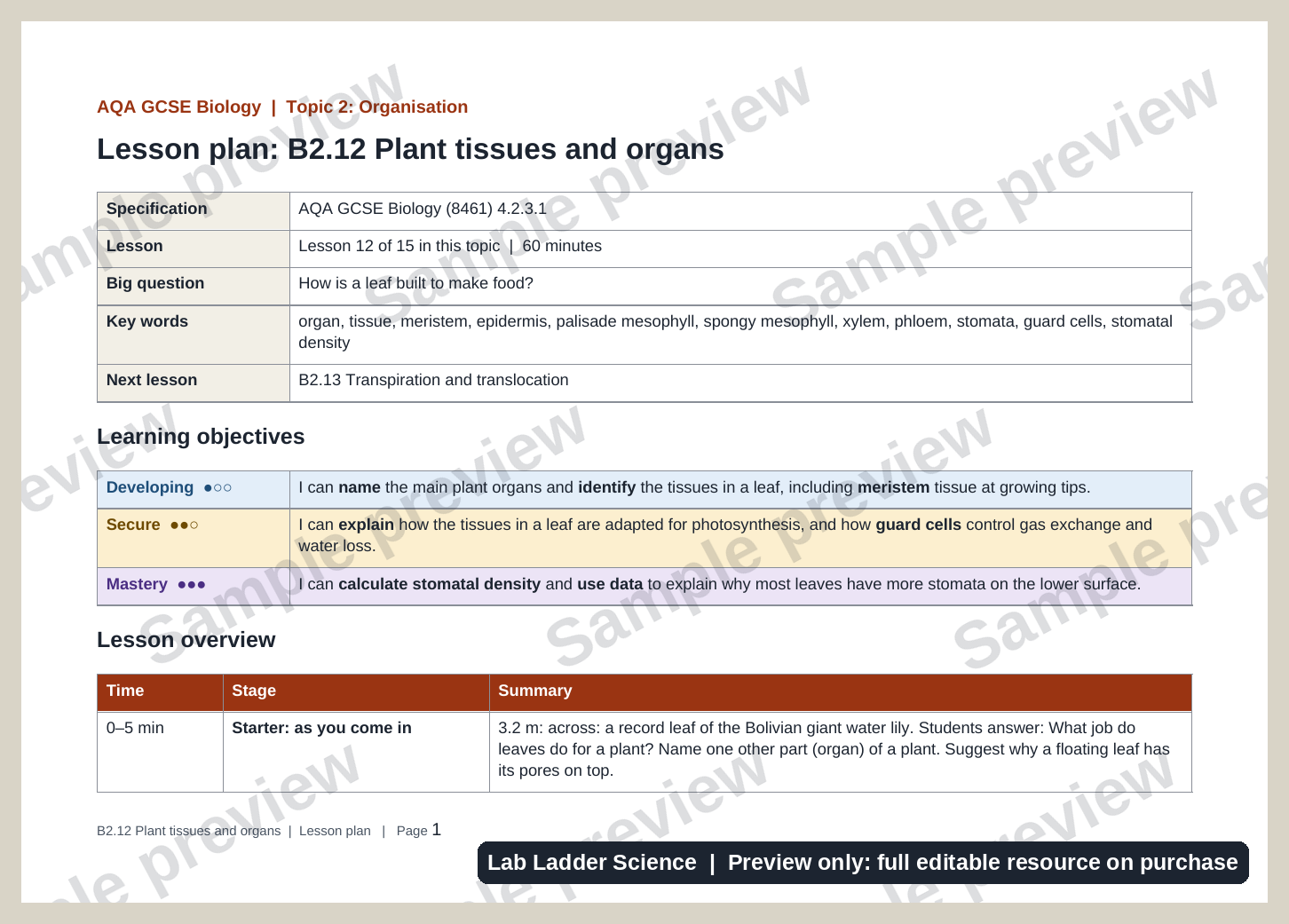
• Starter on screen as students arrive, based on a real-world hook: the Bolivian giant water lily, named in 2022, with floating leaves up to 3.2 m across and stomata on top.
• Learning objectives at three levels of challenge: Developing, Secure and Mastery.
• Three learning activities, each with a core task, a support option, a stretch task and a ‘stand back’ mini-whiteboard check with answers.
• Plenary exit ticket with one question per level, an answers slide for self-assessment and a return to the starter.
• Clear original diagrams: plant organs and meristems, a labelled leaf cross-section, open and closed stomata, and a microscope field of view for counting stomata.
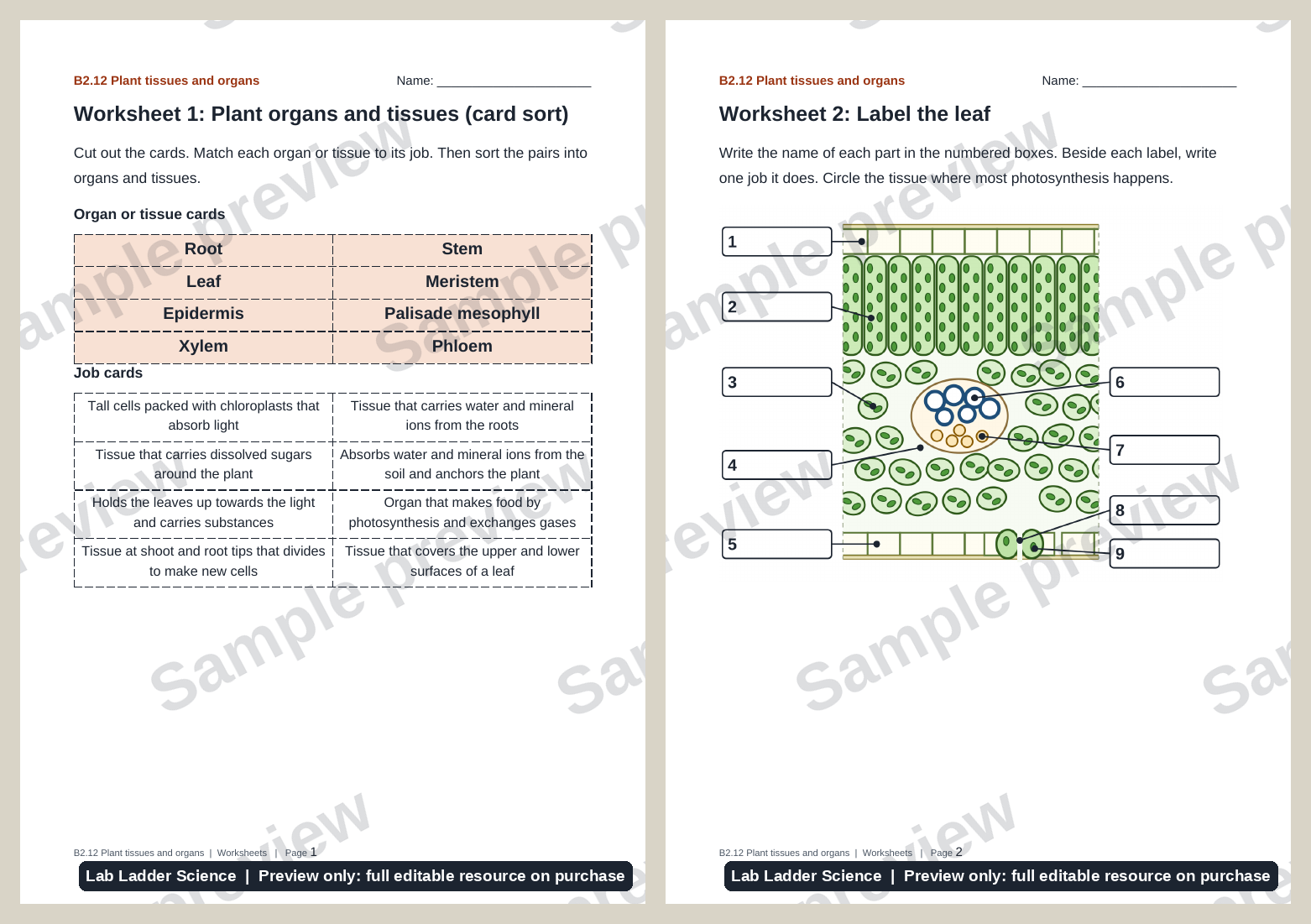
• Editable Word worksheets: an organs and tissues card sort, label the leaf cross-section (blank and hint versions), and stomatal density exam-style questions with calculations (core and support versions).
• Word lesson plan with objectives, lesson sequence, differentiation, answers, common misconceptions and an optional nail varnish stomata practical.
Lesson outline
• Starter (5 min): Why does the world’s largest water lily have its leaf pores on top?
• Activity 1 (15 min): Plant organs, meristems and levels of organisation, with an organs and tissues card sort.
• Activity 2 (15 min): Label a leaf cross-section and link the structure of each tissue to its job in photosynthesis.
• Activity 3 (15 min): How guard cells open and close stomata, then calculate means and stomatal density in exam-style questions.
• Plenary (8 min): Exit ticket at three levels, then self-assessment against the objectives.
Differentiation and inclusion
Every activity offers support and stretch that all students can choose, so no one is singled out. Support includes clue words, first-letter label hints, a word bank and a hint for every exam question. Stretch tasks ask students to explain why meristems are at the tips of shoots and roots, why palisade cells are near the top of the leaf, why a thin, flat leaf helps photosynthesis and why a plant that is short of water photosynthesises more slowly.
The slides follow the British Dyslexia Association Style Guide: a clear sans serif font at a large size, a soft cream background, bold (not italics) for emphasis, left-aligned text and plain English. Levels of challenge never rely on colour alone, diagrams use labels and patterns as well as colour, every slide has a proper title for screen readers, and diagrams include alt text.
How you could use it
• Teach it as a full lesson on leaf structure for Year 9 or Year 10, before transpiration.
• Use it as a ready-made cover lesson: the teacher notes explain every step.
• Pair it with prepared leaf slides or a nail varnish stomata practical (method in the lesson plan).
• Use the label the leaf worksheet, stand back quizzes and exit ticket for retrieval practice before mocks.
Specification coverage
AQA GCSE Biology 8461, section 4.2.3.1 Plant tissues: epidermal tissues, palisade mesophyll, spongy mesophyll, xylem, phloem and meristem tissue; the leaf as a plant organ; how the structure of plant tissues is related to their function. Also 4.2.3.2: roots, stem and leaves as a plant organ system, and the role of stomata and guard cells in controlling gas exchange and water loss. Opportunities for AT 7 (microscopy) and maths skills: means, ratios and area. Key words: organ, tissue, meristem, epidermis, palisade mesophyll, spongy mesophyll, xylem, phloem, stomata, guard cells, stomatal density. The next lesson in the series is transpiration and translocation.
You must log in and be a buyer of this download to submit a review.