Lungs and gas exchange lesson for AQA GCSE Biology 4.2.2.2: gas exchange system, alveoli adaptations, breathing and exam questions with answers.
What is this resource?
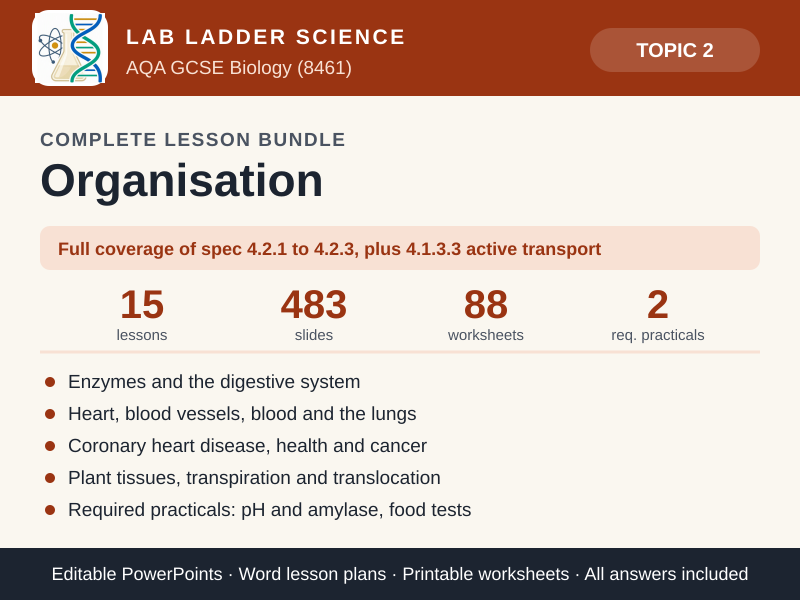
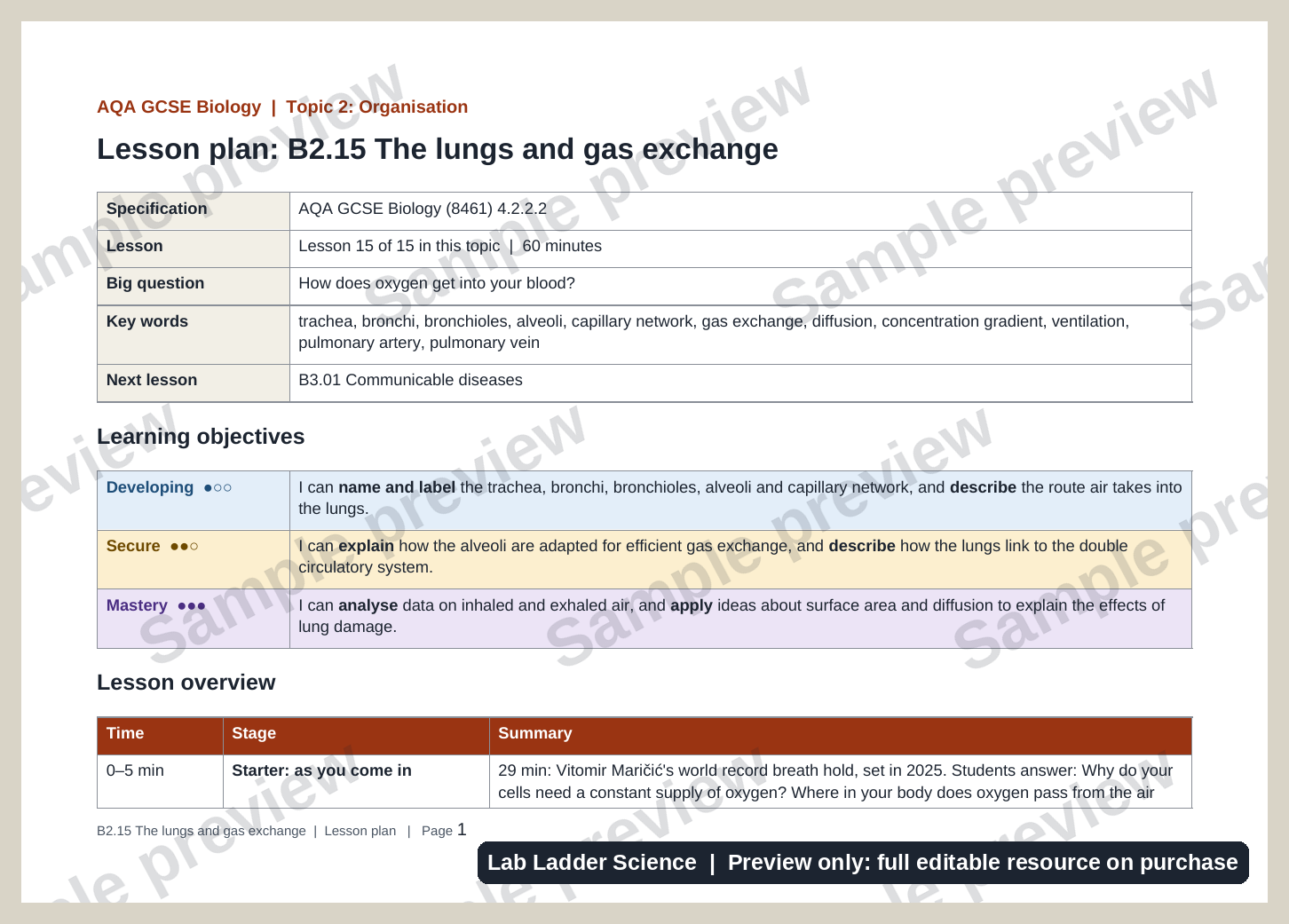
This is a complete lesson on the lungs and gas exchange for AQA GCSE Biology (8461), covering the lungs content of specification point 4.2.2.2. It is Lesson 15 of 15 in Topic 2: Organisation and is designed to last 60 minutes. It fits well straight after the lessons on the heart and blood vessels.
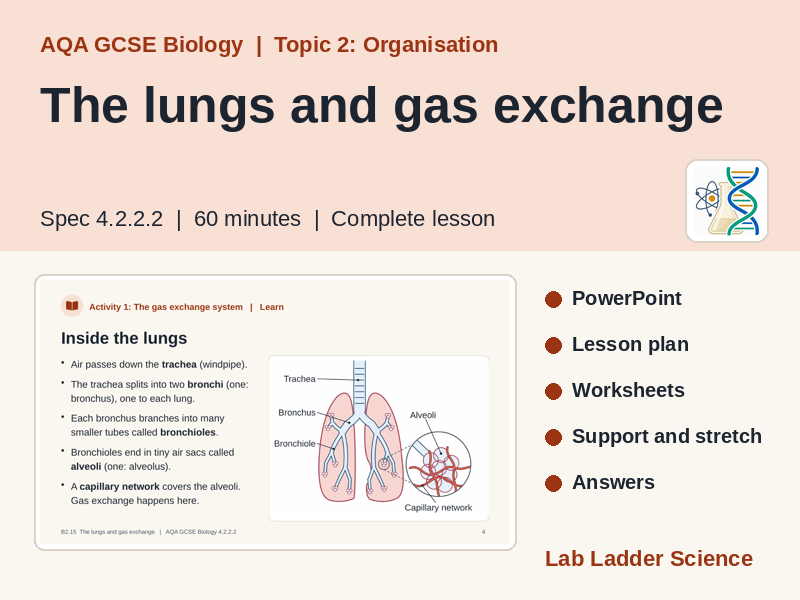
Students learn the structure of the gas exchange system: the trachea, bronchi, bronchioles, alveoli and the capillary network around the alveoli. They explain how the alveoli are adapted for efficient gas exchange, follow blood from the right ventricle through the lungs to the left atrium, compare inhaled and exhaled air, and apply ideas about surface area and diffusion to explain why emphysema makes people breathless. The lesson builds on earlier work on exchange surfaces without repeating it.
What’s included
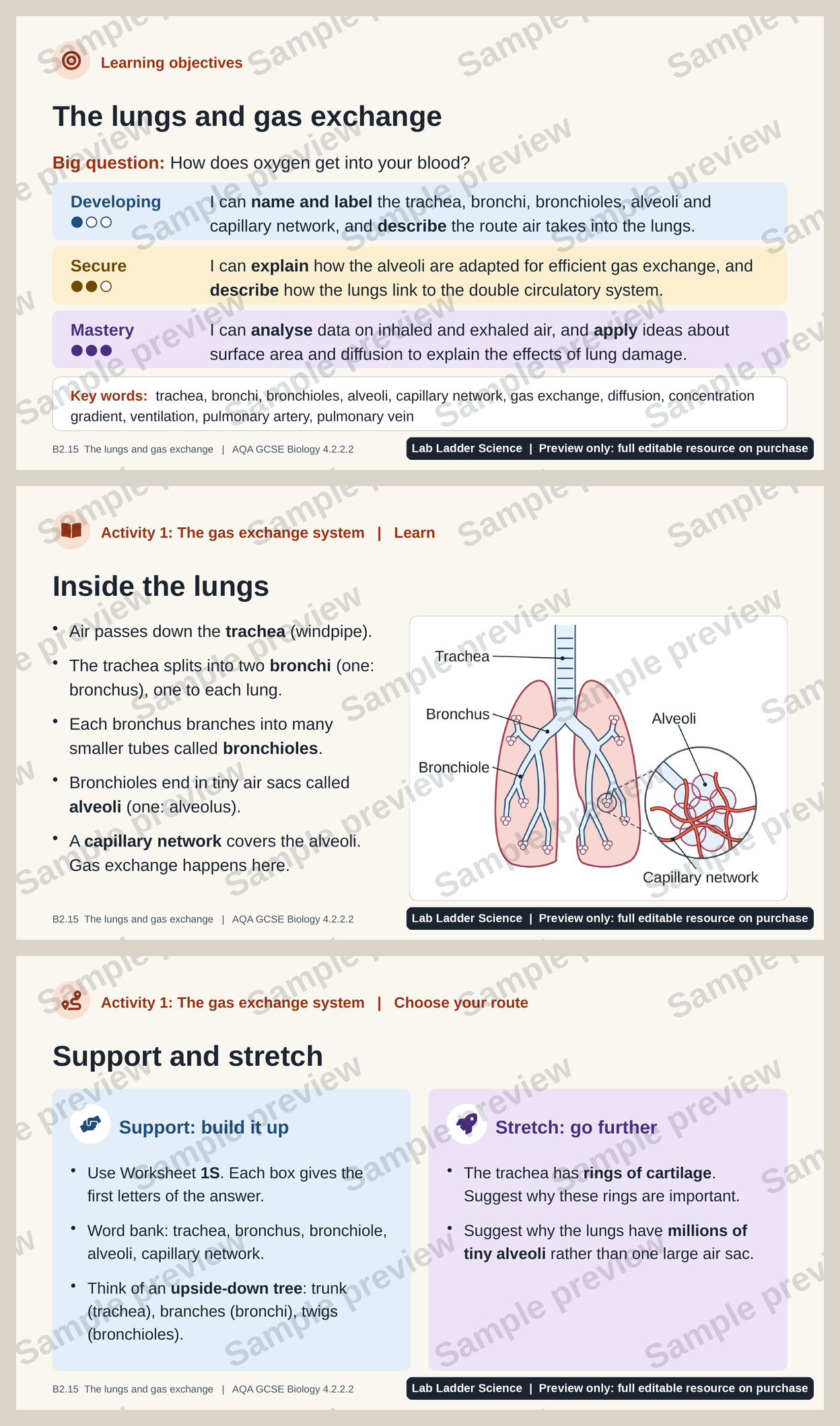
• PowerPoint lesson (34 slides) with full teacher notes on every slide: timings, answers, a full mark scheme, misconceptions, questioning prompts and guidance on handling lung conditions sensitively.
• Starter on screen as students arrive, based on a real-world hook: a free diver’s 29-minute world record breath hold.
• Learning objectives at three levels of challenge: Developing, Secure and Mastery.
• Three learning activities: the gas exchange system, how the alveoli are adapted, and breathing and damaged lungs. Each has a core task, a support option, a stretch task and a ‘stand back’ mini-whiteboard check with answers.
• Clear original diagrams: a labelled gas exchange system with an enlarged view of the alveoli and capillary network, the link between the lungs and the double circulation, a bar chart of inhaled and exhaled air, and healthy and damaged alveoli.
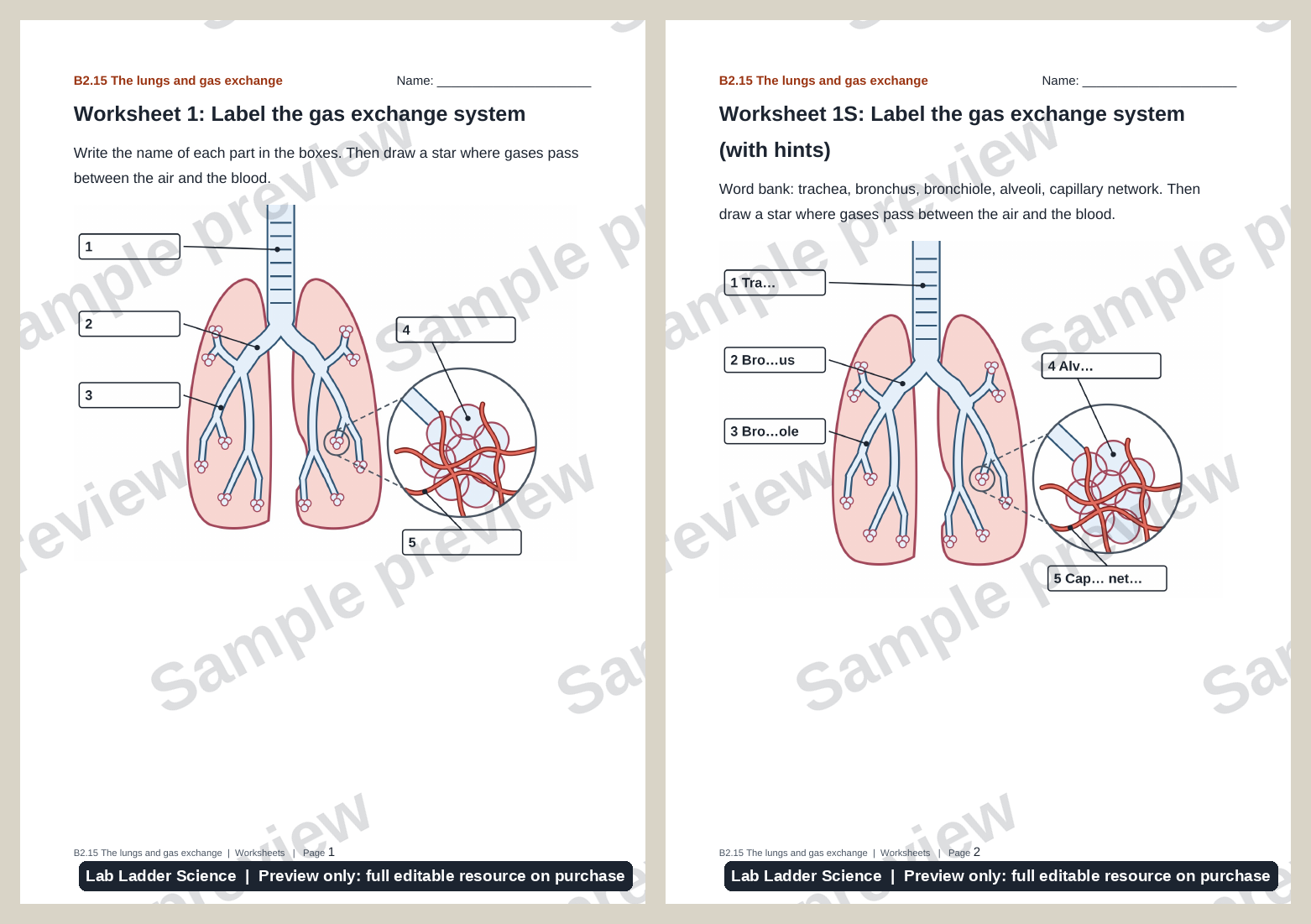
• Editable Word worksheets: label the gas exchange system (core and first-letter hint versions), an adaptations of the lungs table (core and support versions), and seven exam-style questions with a data passage and a percentage calculation (core and hint versions).
• Plenary exit ticket with one question per level, an answers slide for self-assessment and a return to the starter.
• Word lesson plan with objectives, lesson sequence, differentiation, answers and common misconceptions.
Lesson outline
• Starter (5 min): How did a free diver hold his breath for 29 minutes, and where does oxygen enter the blood?
• Activity 1 (15 min): Label the trachea, bronchi, bronchioles, alveoli and capillary network, and describe the route air takes into the lungs.
• Activity 2 (15 min): Follow blood from the right ventricle through the lungs, then explain how each adaptation of the alveoli speeds up diffusion.
• Activity 3 (15 min): Compare inhaled and exhaled air, explain how damaged alveoli affect gas exchange, then answer exam-style questions.
• Plenary (8 min): Exit ticket at three levels, then self-assessment against the objectives.
Differentiation and inclusion
Every activity offers support and stretch that all students can choose, so no one is singled out. Support includes a first-letter hint labelling sheet, word banks, a part-completed adaptations table, sentence starters, a maths tip and hints on every exam question. Stretch tasks ask students to explain the rings of cartilage in the trachea, why carbon dioxide diffuses the opposite way to oxygen, how extra oxygen helps people with emphysema, and how faster breathing helps muscle cells during exercise.
The slides follow the British Dyslexia Association Style Guide: a clear sans serif font at a large size, a soft cream background, bold (not italics) for emphasis, left-aligned text and plain English. Deoxygenated and oxygenated blood are shown with words and line styles, and the bar chart uses labels and patterns, so colour never carries meaning on its own. Every slide has a proper title for screen readers and every diagram has alt text. Teacher notes give guidance on lung conditions, breath-holding safety and alternatives to a lung demonstration.
How you could use it
• Teach it straight after the heart and blood vessels, to complete the circulatory and gas exchange systems.
• Pair it with a lung model or a sheep’s lungs demonstration; the notes show where it fits.
• Use the labelling sheet, adaptations table and exam-style questions for retrieval practice before mocks.
• Use it as a ready-made cover lesson: the teacher notes explain every step.
Specification coverage
AQA GCSE Biology 8461, section 4.2.2.2 The heart and blood vessels: the structure and functioning of the lungs, including how the lungs are adapted for gaseous exchange, and the right ventricle pumping blood to the lungs where gas exchange takes place. Key words: trachea, bronchi, bronchioles, alveoli, capillary network, gas exchange, diffusion, concentration gradient, ventilation, pulmonary artery, pulmonary vein. The next lesson in the series is B3.01 Communicable diseases.
You must log in and be a buyer of this download to submit a review.