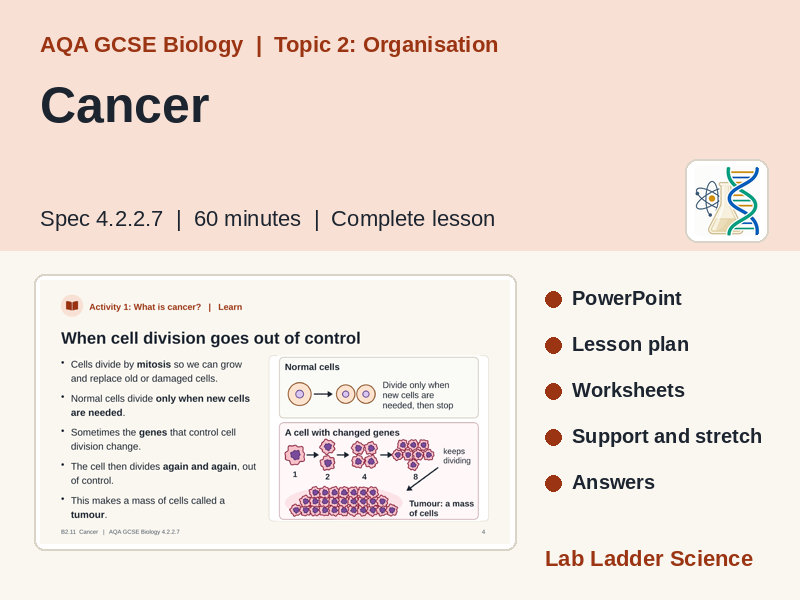
Cancer lesson for AQA GCSE Biology 4.2.2.7: benign and malignant tumours, secondary tumours, risk factors, data analysis, worksheets and answers.
What is this resource?
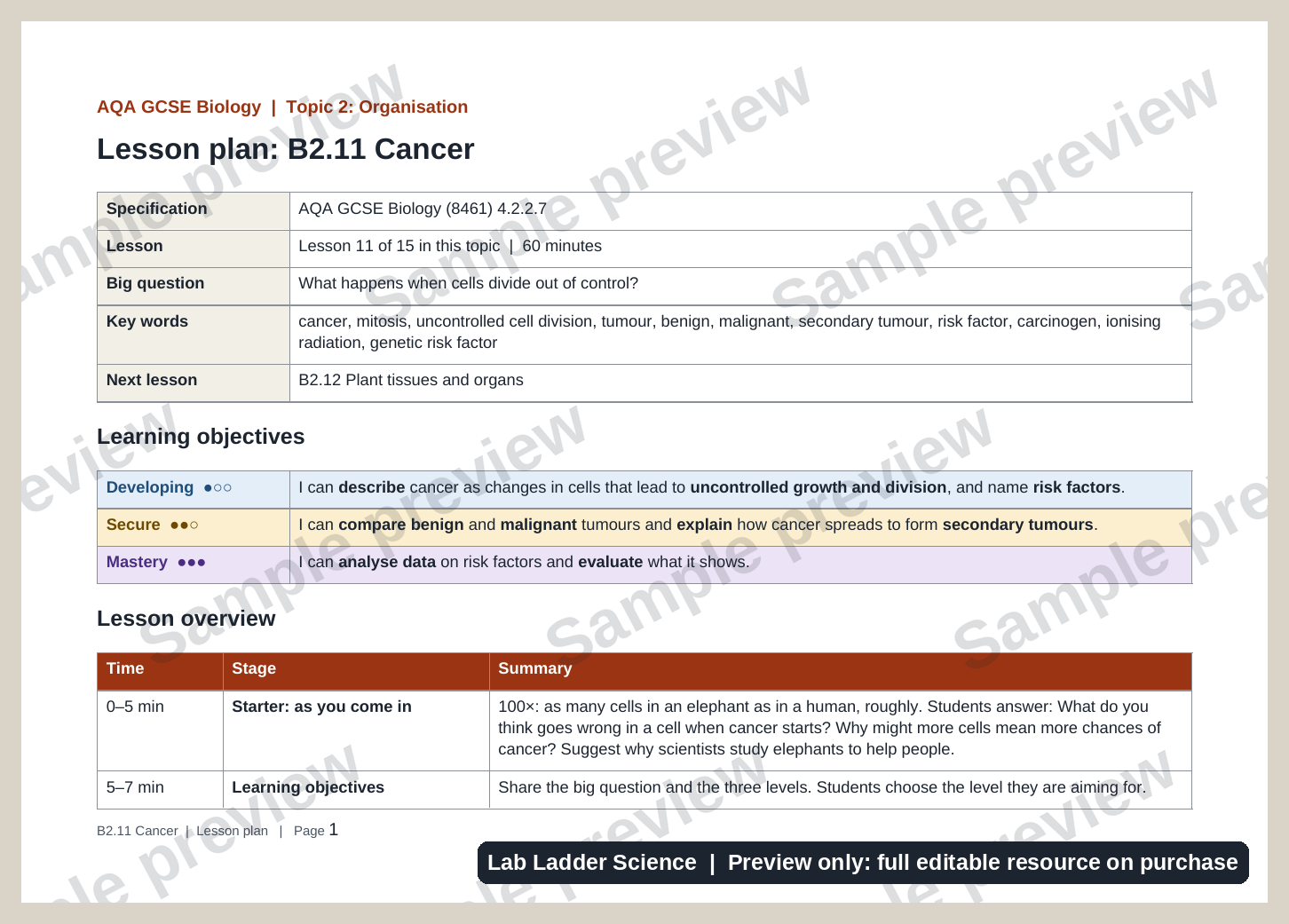
This is a complete lesson on cancer for AQA GCSE Biology (8461), covering specification point 4.2.2.7. It is lesson 11 of 14 in Topic 2: Organisation and is designed to last 60 minutes.
Students learn that cancer is the result of changes in cells that lead to uncontrolled growth and division. They compare benign and malignant tumours, explain how cancer cells invade nearby tissue and travel in the blood to form secondary tumours, and learn about lifestyle and genetic risk factors, including carcinogens, ionising radiation and viruses, before analysing real UK data on risk factors.
What’s included
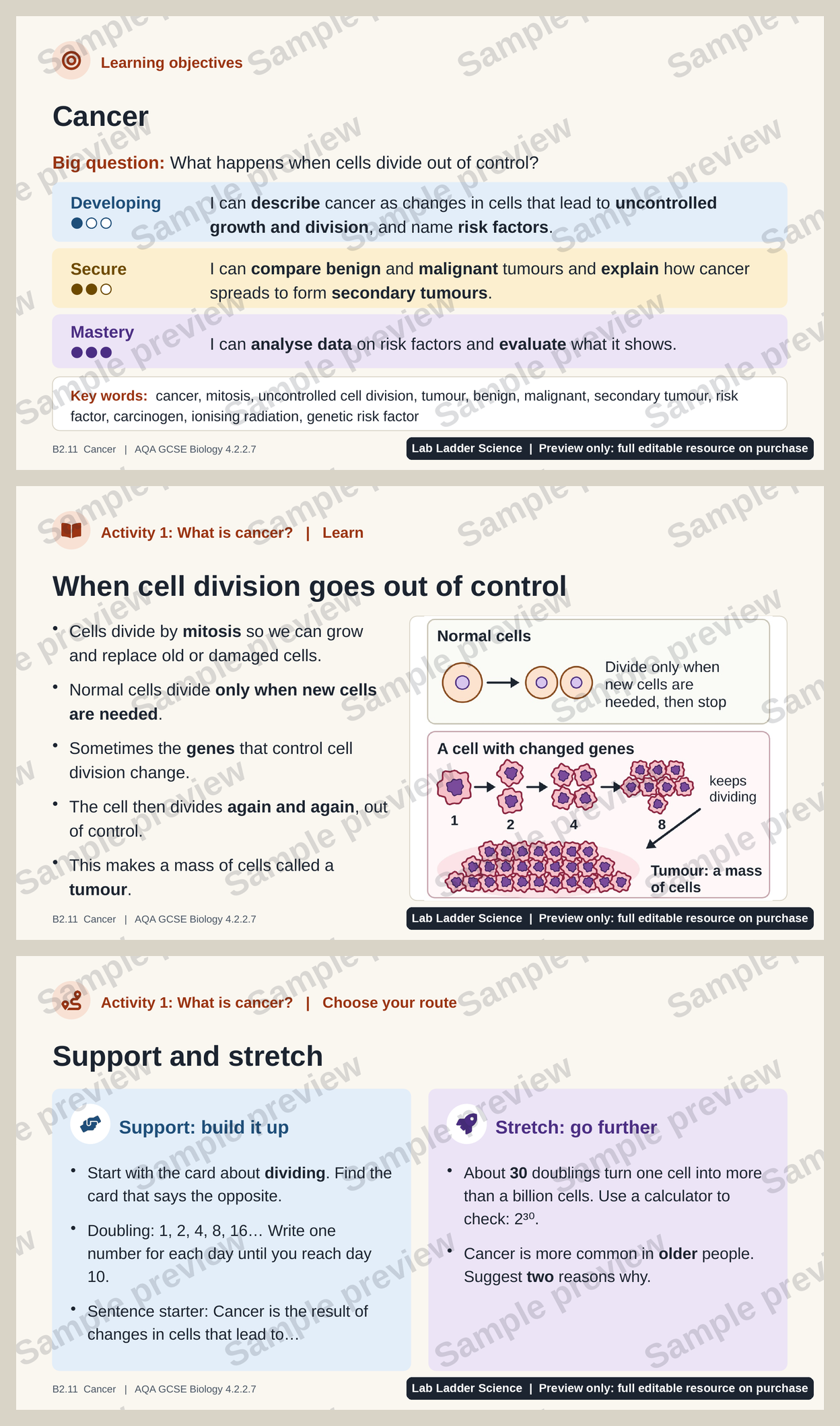
• PowerPoint lesson (32 slides) with full teacher notes on every slide: timings, answers, misconceptions, questioning prompts and sensitivity guidance.
• Starter on screen as students arrive, based on a real-world hook: elephants have about 100 times as many cells as humans, yet very few die of cancer.
• Learning objectives at three levels of challenge: Developing, Secure and Mastery.
• Three learning activities, each with a core task, a support option, a stretch task and a ‘stand back’ mini-whiteboard check with answers.
• Plenary exit ticket with one question per level, an answers slide for self-assessment and a return to the starter.
• Clear original diagrams: normal and uncontrolled cell division, a benign tumour, a malignant tumour, how cancer spreads, and a bar chart of UK cancer risk factor data.
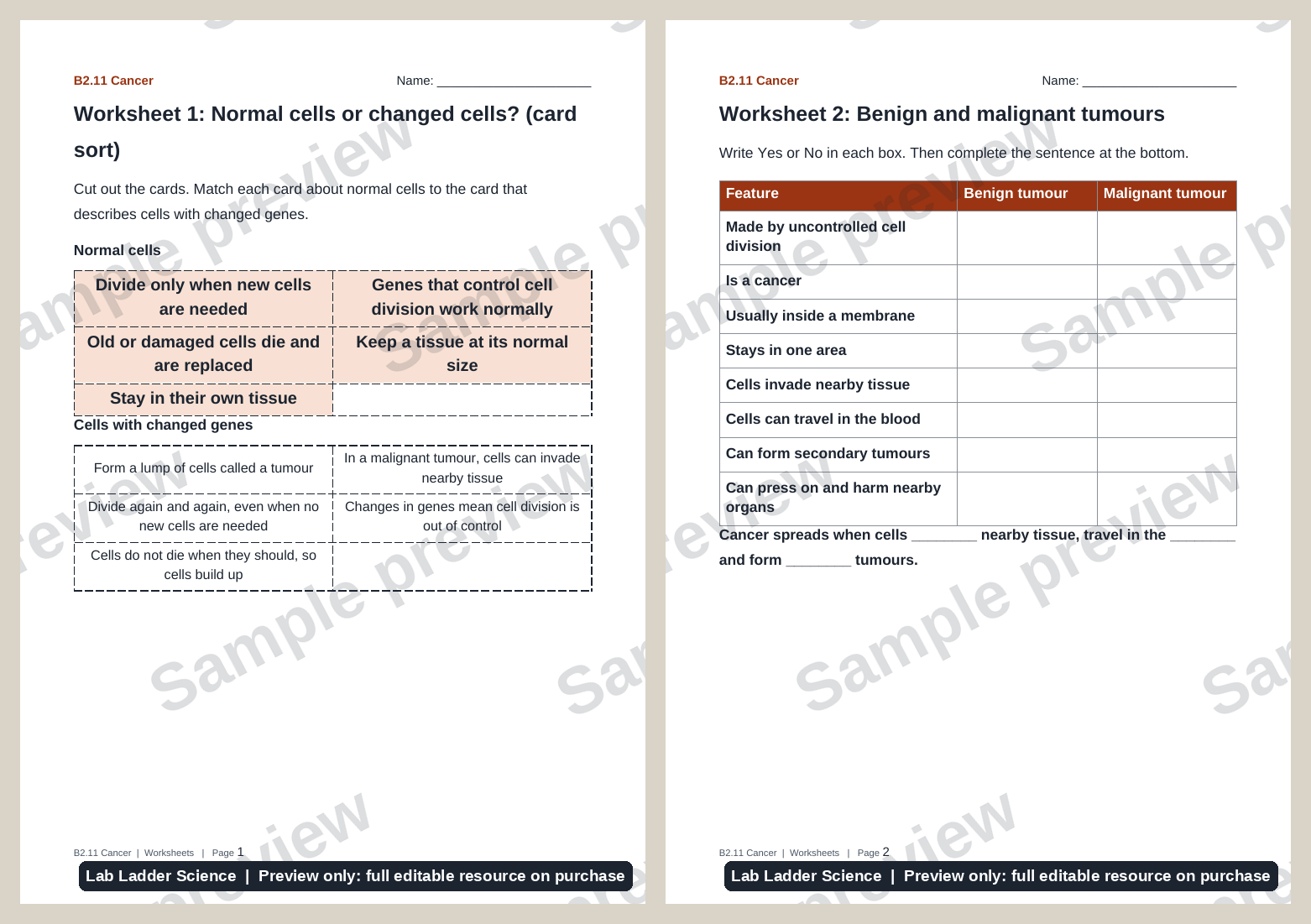
• Editable Word worksheets: a normal and changed cells card sort, a benign and malignant tumours comparison table (core and support versions), a risk factor data sheet, and exam-style questions with calculations (core and support versions).
• Word lesson plan with objectives, lesson sequence, differentiation, answers, common misconceptions and guidance on teaching this topic sensitively.
Lesson outline
• Starter (5 min): Why do so few elephants die of cancer when they have so many cells?
• Activity 1 (15 min): What is cancer? Learn how uncontrolled cell division forms a tumour, then match normal and changed cell cards and model cell doubling.
• Activity 2 (15 min): Compare benign and malignant tumours in a table and explain in three steps how cancer spreads to form secondary tumours.
• Activity 3 (15 min): Learn about lifestyle, environmental and genetic risk factors, then analyse UK data in exam-style questions with ratio and percentage calculations.
• Plenary (8 min): Exit ticket at three levels, then self-assessment against the objectives.
Differentiation and inclusion
Every activity offers support and stretch that all students can choose, so no one is singled out. Support includes sentence starters, part-completed tables, memory aids and a hint for every exam question. Stretch tasks ask students to explain why cancer is more common in older people, why a benign brain tumour can be serious, how the HPV vaccine can reduce cancer cases, and why a correlation alone does not prove a cause.
Cancer can be a personal topic. The teacher notes include clear guidance on preparing affected students, avoiding blame, using calm and accurate language, responding to disclosures and signposting support such as Childline and Hope Support Services. The slides follow the British Dyslexia Association Style Guide: a clear sans serif font at a large size, a soft cream background, bold (not italics) for emphasis, left-aligned text and plain English. Levels of challenge never rely on colour alone, every slide has a proper title for screen readers, and diagrams include alt text.
How you could use it
• Teach it as a full lesson on cancer for Year 10, after lessons on mitosis and non-communicable diseases.
• Use it as a ready-made cover lesson: the teacher notes explain every step.
• Use the data sheet and exam-style questions for maths skills practice or homework.
• Use the stand back quizzes and exit ticket for retrieval practice before mocks.
Specification coverage
AQA GCSE Biology 8461, section 4.2.2.7 Cancer: cancer as the result of changes in cells that lead to uncontrolled growth and division; benign tumours; malignant tumours invading neighbouring tissues and spreading in the blood to form secondary tumours; lifestyle and genetic risk factors. Links to 4.2.2.6 (carcinogens and ionising radiation as risk factors) and 4.1.2.2 (mitosis). Key words: cancer, mitosis, uncontrolled cell division, tumour, benign, malignant, secondary tumour, risk factor, carcinogen, ionising radiation, genetic risk factor. The next lesson in the series is plant tissues and organs.
You must log in and be a buyer of this download to submit a review.