Health and non-communicable diseases lesson for AQA GCSE Biology 4.2.2.5-6: risk factors, correlation and data. PowerPoint, worksheets, answers.
What is this resource?
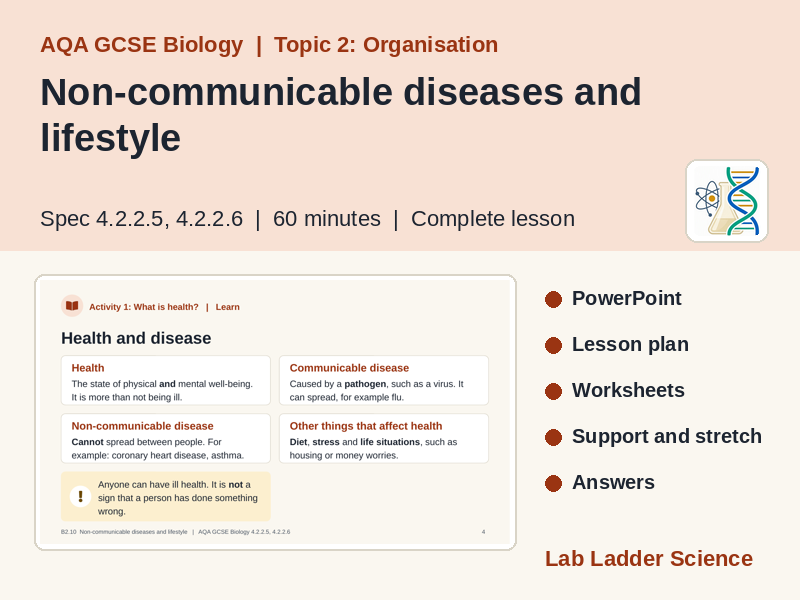
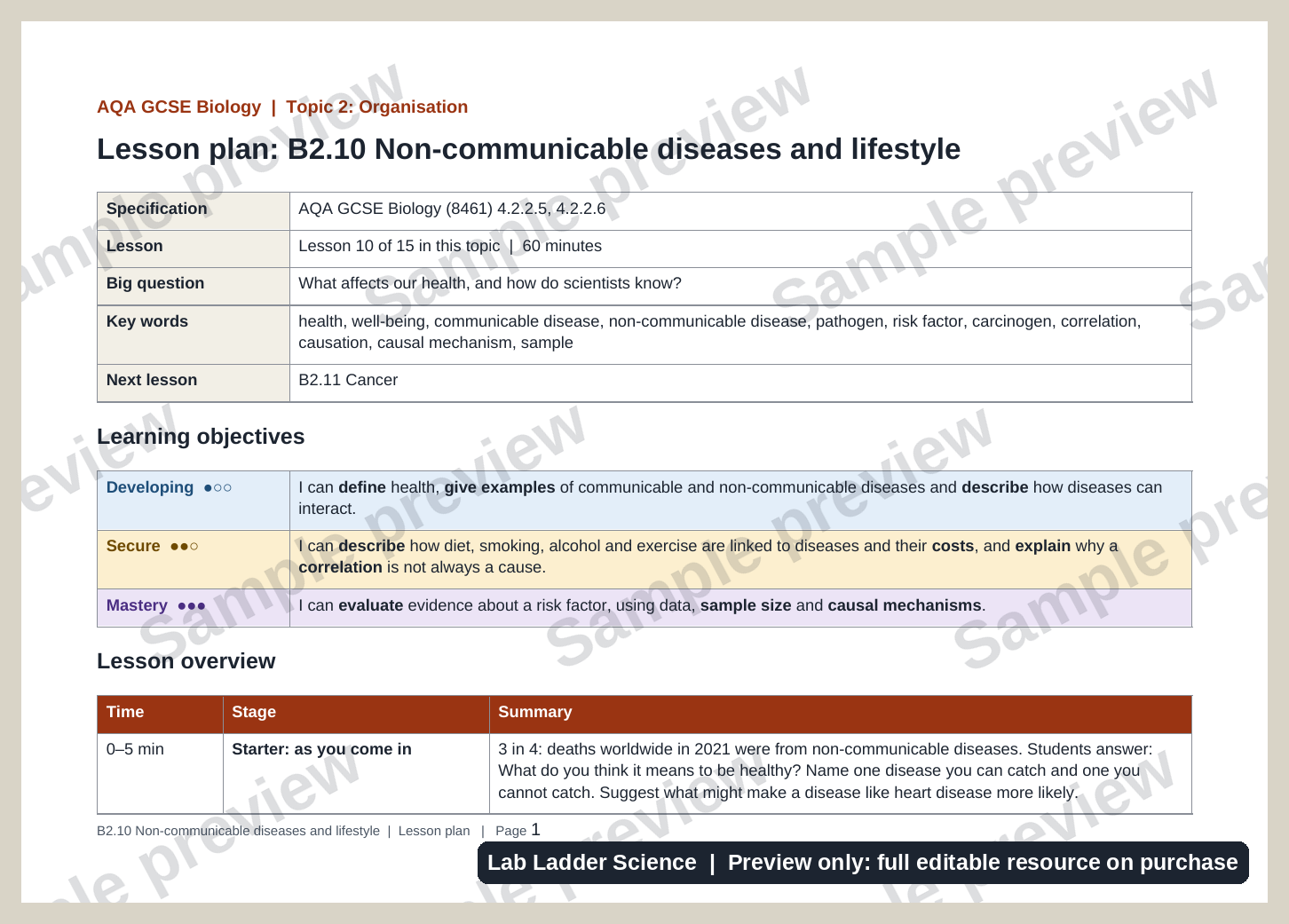
This is a complete lesson on health, lifestyle and non-communicable diseases for AQA GCSE Biology (8461), covering specification points 4.2.2.5 and 4.2.2.6. It is the tenth lesson in Topic 2: Organisation and is designed to last 60 minutes.
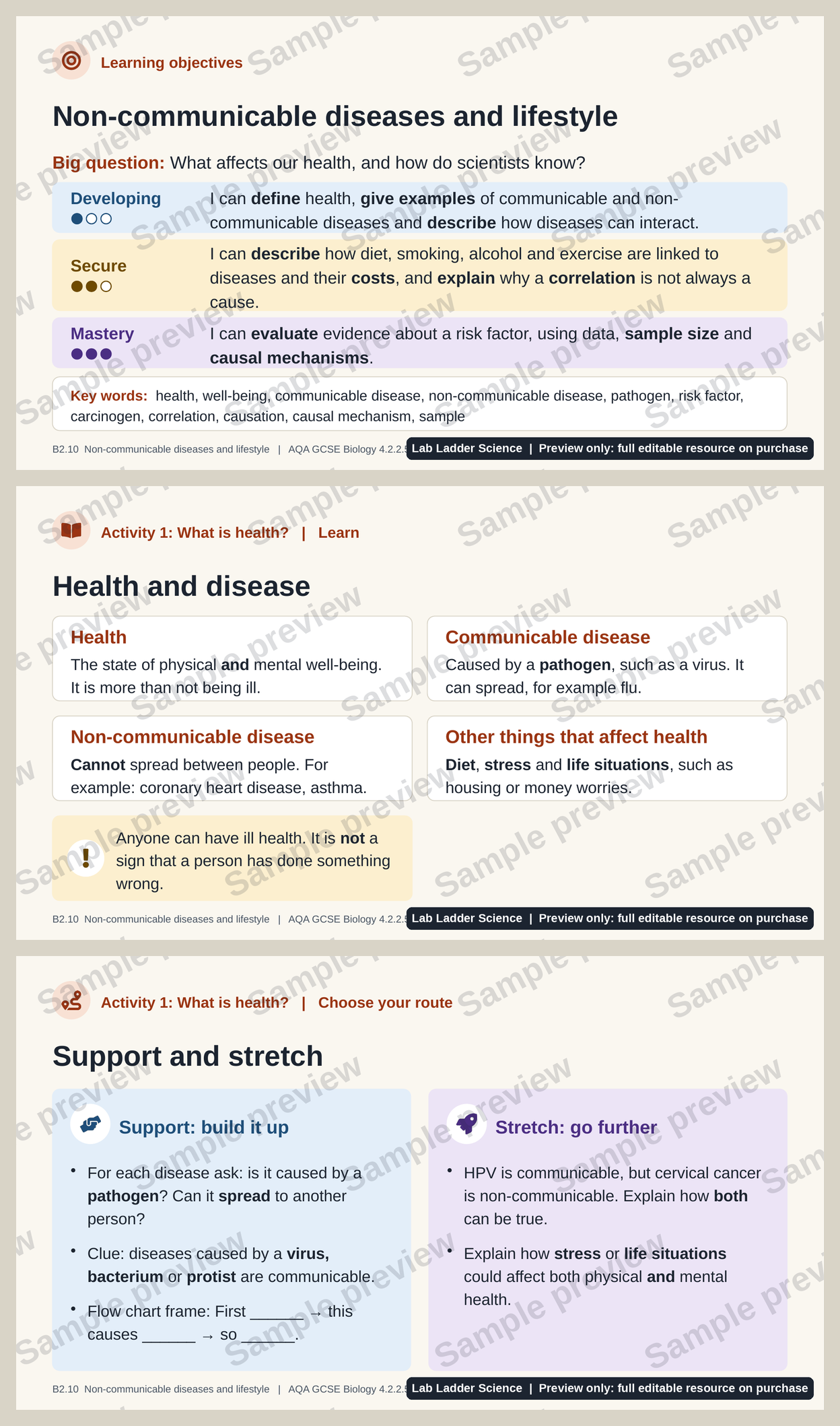
Students learn that health is the state of physical and mental well-being, compare communicable and non-communicable diseases, and describe how diseases can interact. They link risk factors such as diet, smoking, alcohol, exercise, obesity and ionising radiation to diseases, discuss the human and financial costs of non-communicable diseases, and analyse scatter diagrams to decide whether a correlation shows causation. The lesson also covers the principles of sampling and a percentage calculation using real World Health Organization data.
What’s included
• PowerPoint lesson (34 slides) with full teacher notes on every slide: timings, answers, mark schemes, misconceptions and questioning prompts.
• Starter on screen as students arrive, based on a real-world hook: 3 in 4 deaths worldwide (not counting the pandemic) are caused by non-communicable diseases.
• Learning objectives at three levels of challenge: Developing, Secure and Mastery.
• Three learning activities, each with a core task, a support option, a stretch task and a ‘stand back’ mini-whiteboard check with answers.
• Plenary exit ticket with one question per level, an answers slide for self-assessment and a return to the starter.
• Clear original graphs: positive, negative and no correlation, a scatter diagram on smoking and lung cancer, and a scatter diagram on alcohol and liver disease with a point that does not fit the pattern.
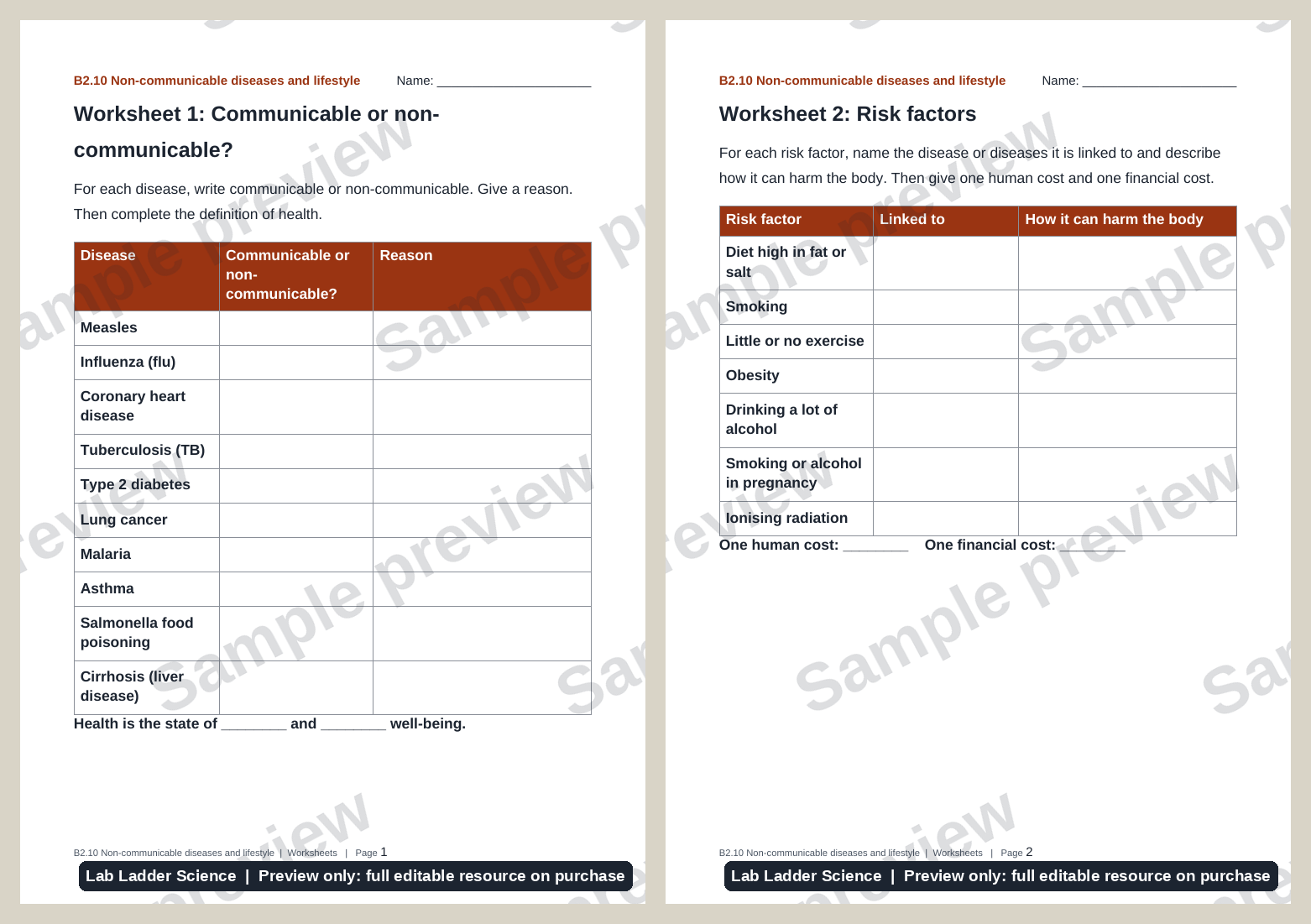
• Editable Word worksheets: communicable or non-communicable disease sort, a risk factors table (core and support versions), a graph sheet, and a 16-mark set of exam-style questions on data, sampling and costs (core and support versions).
• Word lesson plan with objectives, lesson sequence, differentiation, mark schemes and common misconceptions.
Lesson outline
• Starter (5 min): What does it mean to be healthy, and which diseases can you not catch?
• Activity 1 (15 min): Define health, sort communicable and non-communicable diseases, and draw a flow chart showing how diseases interact.
• Activity 2 (15 min): Link risk factors to non-communicable diseases and discuss their human and financial costs.
• Activity 3 (15 min): Read scatter diagrams, tell correlation from causation, and answer exam-style data questions.
• Plenary (8 min): Exit ticket at three levels, then self-assessment against the objectives.
Differentiation and inclusion
Every activity offers support and stretch that all students can choose, so no one is singled out. Support includes clue questions, a flow chart frame, a part-completed risk factors table with a word bank, and a support version of the exam questions with hints and sentence frames. Stretch tasks ask students to explain how HPV and cervical cancer show diseases interacting, why it is hard to prove that one lifestyle factor causes a disease, why governments fund healthy lifestyle campaigns, and why carrying a lighter is linked to lung cancer without causing it.
The lesson is written to be sensitive and non-judgemental. It talks about risk in populations rather than individuals, stresses that many risk factors are outside a person’s control, and does not ask students to measure their weight or share personal or family health information. Teacher notes give guidance on handling weight, smoking, alcohol, illness and mental health with care. The slides follow the British Dyslexia Association Style Guide: a clear sans serif font at a large size, a soft cream background, bold (not italics) for emphasis, left-aligned text and plain English. Graphs use labels and marker shapes rather than colour, and all diagrams include alt text.
How you could use it
• Teach it as a full lesson on health and non-communicable diseases for Year 10 or Year 11.
• Use it as a ready-made cover lesson: the teacher notes explain every step.
• Use the graph and exam-style questions to practise data analysis, correlation and sampling skills before mocks.
• Use the worksheets on their own for homework or revision.
Specification coverage
AQA GCSE Biology 8461, sections 4.2.2.5 Health issues and 4.2.2.6 The effect of lifestyle on some non-communicable diseases, including the maths skills of translating between graphs and numbers, using a scatter diagram to identify a correlation, and the principles of sampling. Key words: health, well-being, communicable disease, non-communicable disease, pathogen, risk factor, carcinogen, correlation, causation, causal mechanism, sample. The previous lesson in the series is on blood, and the next lesson covers cancer.
You must log in and be a buyer of this download to submit a review.