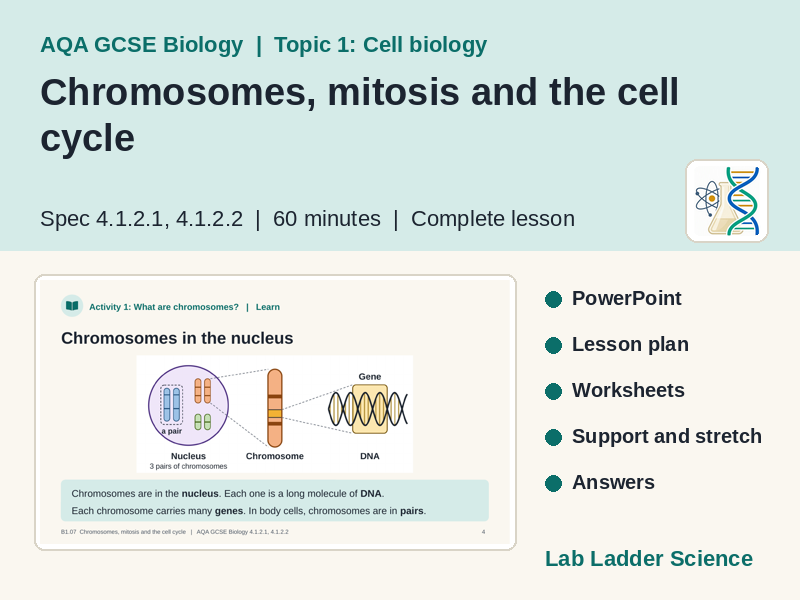
Mitosis and the cell cycle lesson for AQA GCSE Biology 4.1.2.1 and 4.1.2.2. Chromosomes, cell cycle diagrams, worksheets and full answers.
What is this resource?
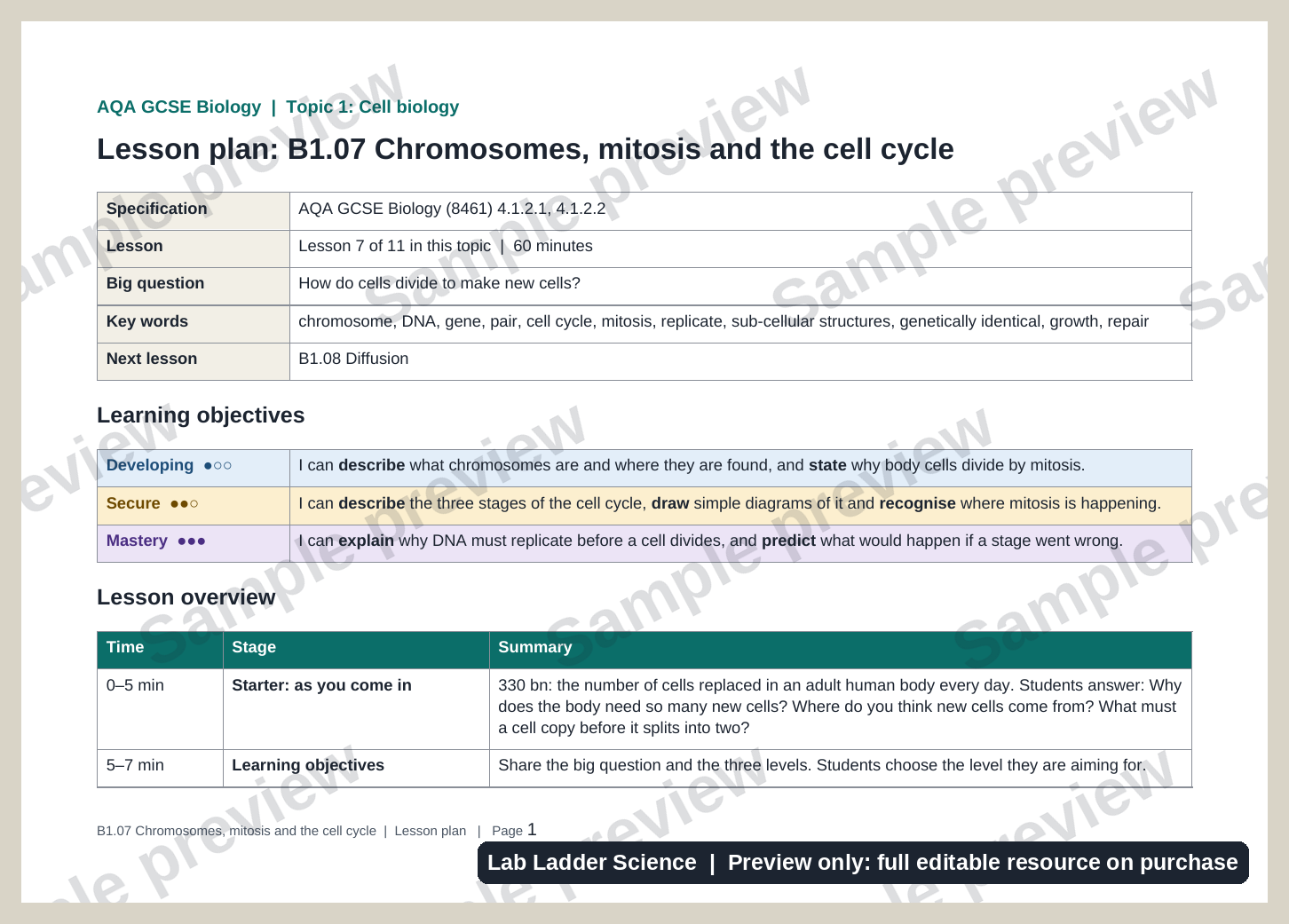
This is a complete lesson on chromosomes, mitosis and the cell cycle for AQA GCSE Biology (8461), covering specification points 4.1.2.1 and 4.1.2.2. It is lesson 7 of 11 in Topic 1: Cell biology and is designed to last 60 minutes.
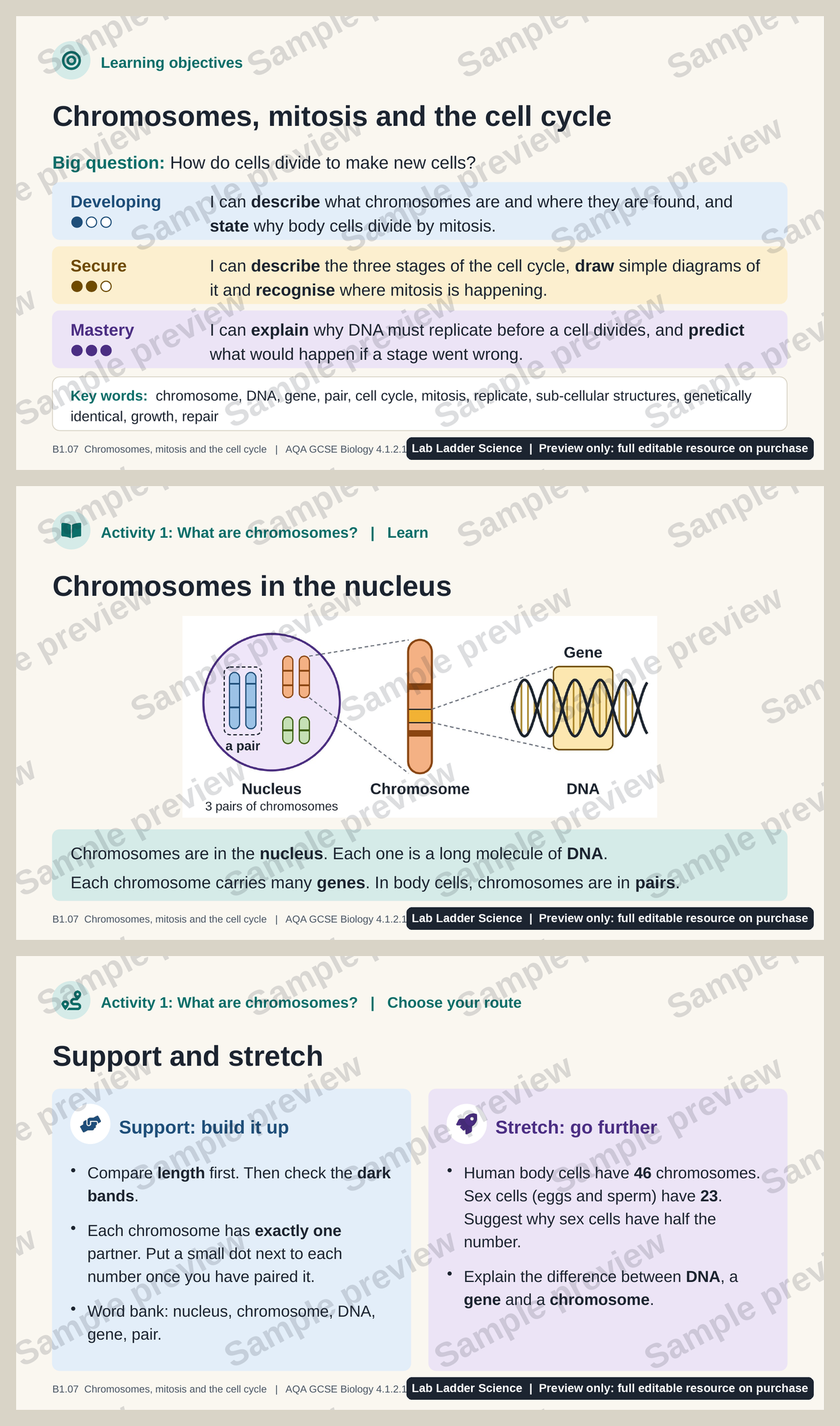
Students learn that chromosomes are found in the nucleus, are made of DNA, carry a large number of genes and are found in pairs in body cells. They then learn the three overall stages of the cell cycle: growth and DNA replication, mitosis, and division of the cytoplasm and cell membrane to form two genetically identical cells. The lesson matches the specification: it does not teach the names of the phases of mitosis.
What’s included
• PowerPoint lesson (28 slides) with full teacher notes on every slide: timings, answers, misconceptions and questioning prompts.
• Starter on screen as students arrive, based on a real-world hook: the body replaces about 330 billion cells every day.
• Learning objectives at three levels of challenge: Developing, Secure and Mastery.
• Three learning activities, each with a core task, a support option, a stretch task and a ‘stand back’ mini-whiteboard check with answers.
• Plenary exit ticket with one question per level, an answers slide for self-assessment and a return to the starter.
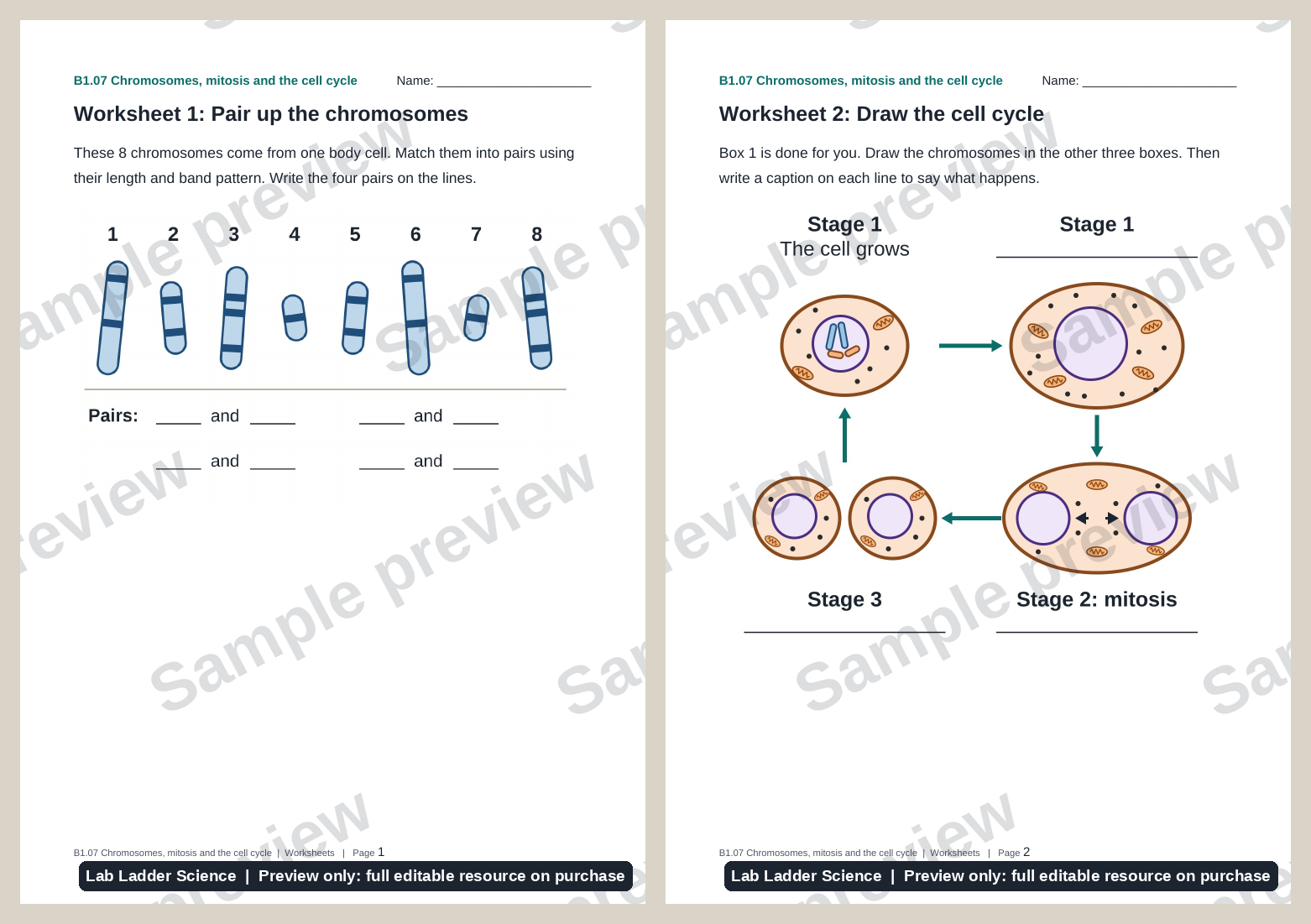
• Original diagrams: a zoom from nucleus to chromosome to gene, a clear cell cycle diagram showing copied chromosomes, and a chromosome pairing activity.
• Editable Word worksheets: pair up the chromosomes, draw the cell cycle (core and support versions) and exam-style ‘what would happen if’ questions (core and support versions).
• Word lesson plan with objectives, lesson sequence, differentiation, answers and common misconceptions.
Lesson outline
• Starter (5 min): Where do 330 billion new cells a day come from?
• Activity 1 (12 min): Learn what chromosomes are, then match chromosomes into pairs by length and band pattern.
• Activity 2 (18 min): Learn the three stages of the cell cycle, then complete a cell cycle diagram by drawing the chromosomes.
• Activity 3 (15 min): Recognise where mitosis happens and answer ‘what would happen if’ questions about the cell cycle going wrong.
• Plenary (8 min): Exit ticket at three levels, then self-assessment against the objectives.
Differentiation and inclusion
Every activity offers support and stretch that all students can choose, so no one is singled out. Support includes a step-by-step pairing strategy, dotted chromosomes to trace, captions with first letters, key facts and sentence starters. Stretch tasks ask students to explain why sex cells have half the number of chromosomes, why DNA must replicate before division and how to see mitosis in a root tip.
Teacher notes include guidance on handling sensitive topics, such as chromosome differences and cancer, with accurate and respectful language. The slides follow the British Dyslexia Association Style Guide: a clear sans serif font at a large size, a soft cream background, bold (not italics) for emphasis, left-aligned text and plain English. Levels of challenge never rely on colour alone, and diagrams include alt text.
How you could use it
• Teach it as a full lesson on cell division for Year 9 or Year 10.
• Use it as a ready-made cover lesson: the teacher notes explain every step.
• Use the cell cycle worksheet as a revision card before assessments.
• Use the stand back quizzes and exit ticket for retrieval practice before mocks.
Specification coverage
AQA GCSE Biology 8461, sections 4.1.2.1 Chromosomes and 4.1.2.2 Mitosis and the cell cycle. Key words: chromosome, DNA, gene, nucleus, pairs, cell cycle, mitosis, DNA replication, sub-cellular structures, genetically identical, growth, repair. The next lesson in the series is diffusion.
You must log in and be a buyer of this download to submit a review.