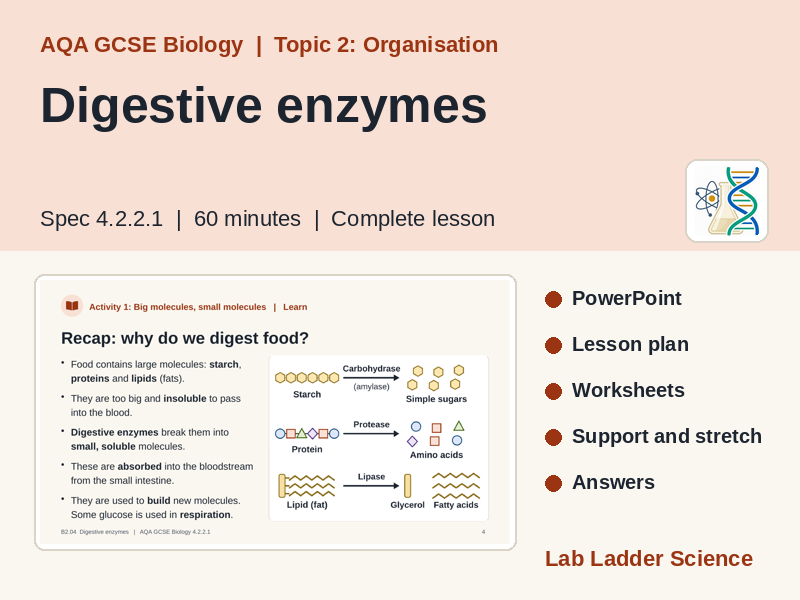
Digestive enzymes lesson for AQA GCSE Biology 4.2.2.1: carbohydrases, proteases, lipases, where they are made, bile, worksheets and answers.
What is this resource?
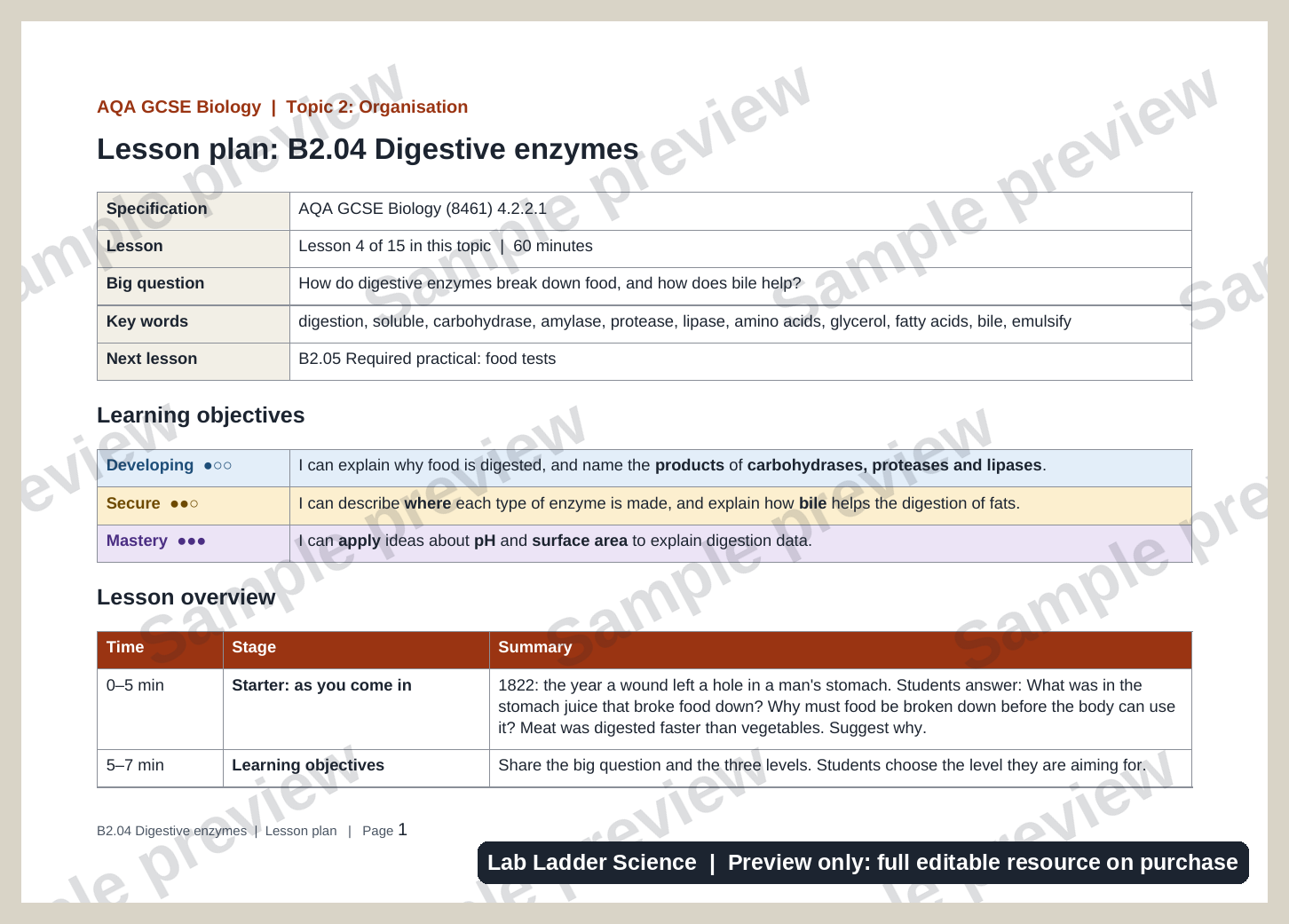
This is a complete lesson on digestive enzymes and bile for AQA GCSE Biology (8461), covering specification point 4.2.2.1 The human digestive system. It is Lesson 4 of 14 in Topic 2: Organisation and is designed to last 60 minutes.
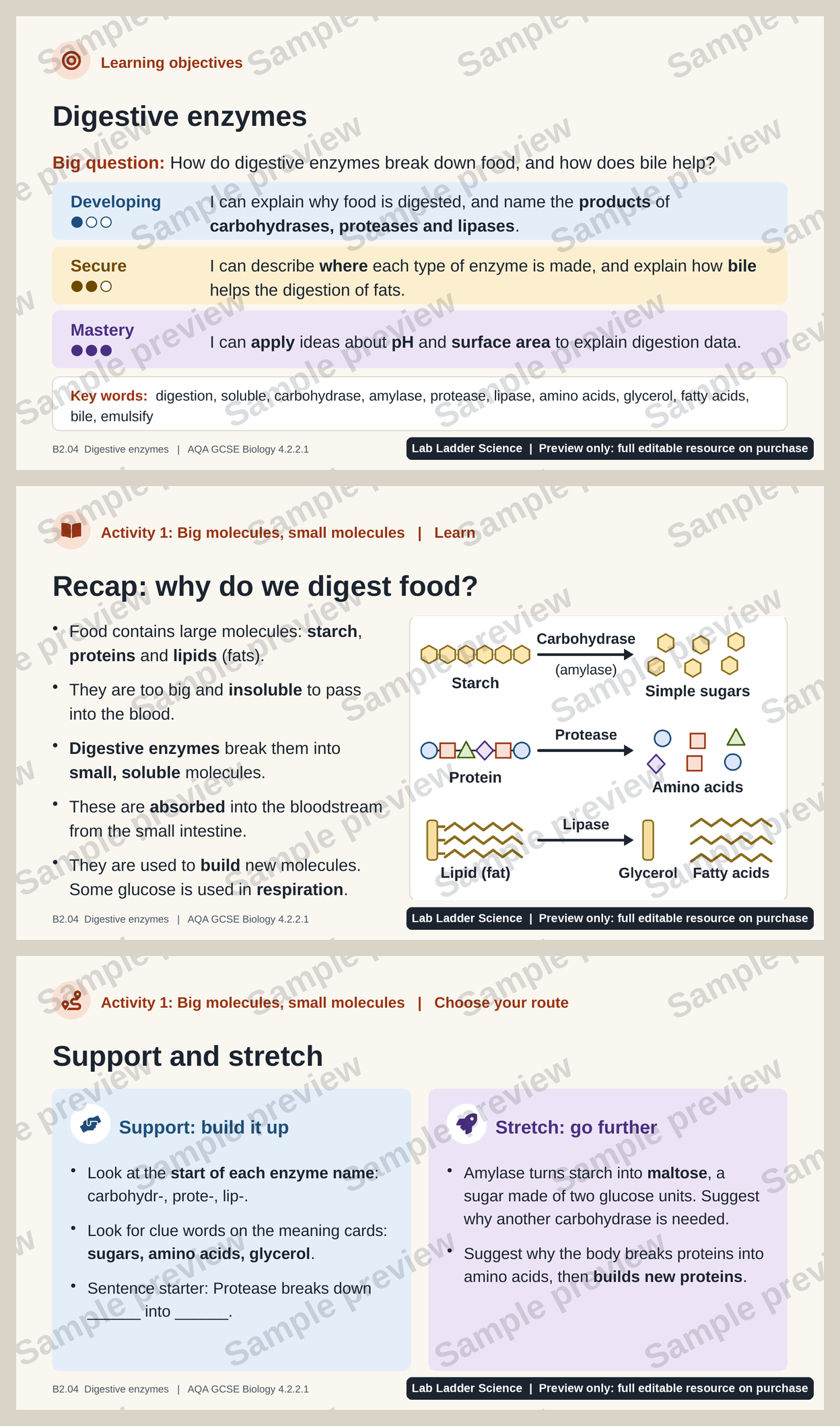
Students learn why large food molecules must be digested into small, soluble molecules that can be absorbed into the bloodstream. They learn what carbohydrases (including amylase), proteases and lipases break down, the products of each, and how the body uses those products. They then map where each enzyme is made, and explain how bile, made in the liver and stored in the gall bladder, emulsifies fat and neutralises stomach acid to speed up fat digestion by lipase.
What’s included
• PowerPoint lesson (31 slides) with full teacher notes on every slide: timings, answers, a mark scheme, misconceptions, demonstration instructions and questioning prompts.
• Starter on screen as students arrive, based on a real-world hook: the 1822 case of Alexis St Martin and William Beaumont’s experiments on digestion, with a teacher note on handling the history sensitively and discussing research ethics.
• Learning objectives at three levels of challenge: Developing, Secure and Mastery.
• Three learning activities: big molecules and small molecules, where enzymes are made, and bile and fat digestion. Each has a core task, a support option, a stretch task and a ‘stand back’ mini-whiteboard check with answers.
• Clear original diagrams: a model of starch, protein and lipid breakdown, a labelled digestive system showing where each enzyme and bile are made, an emulsification diagram showing surface area, and a graph comparing the optimum pH of stomach and small intestine proteases.
• Plenary exit ticket with one question per level, an answers slide for self-assessment and a return to the starter.
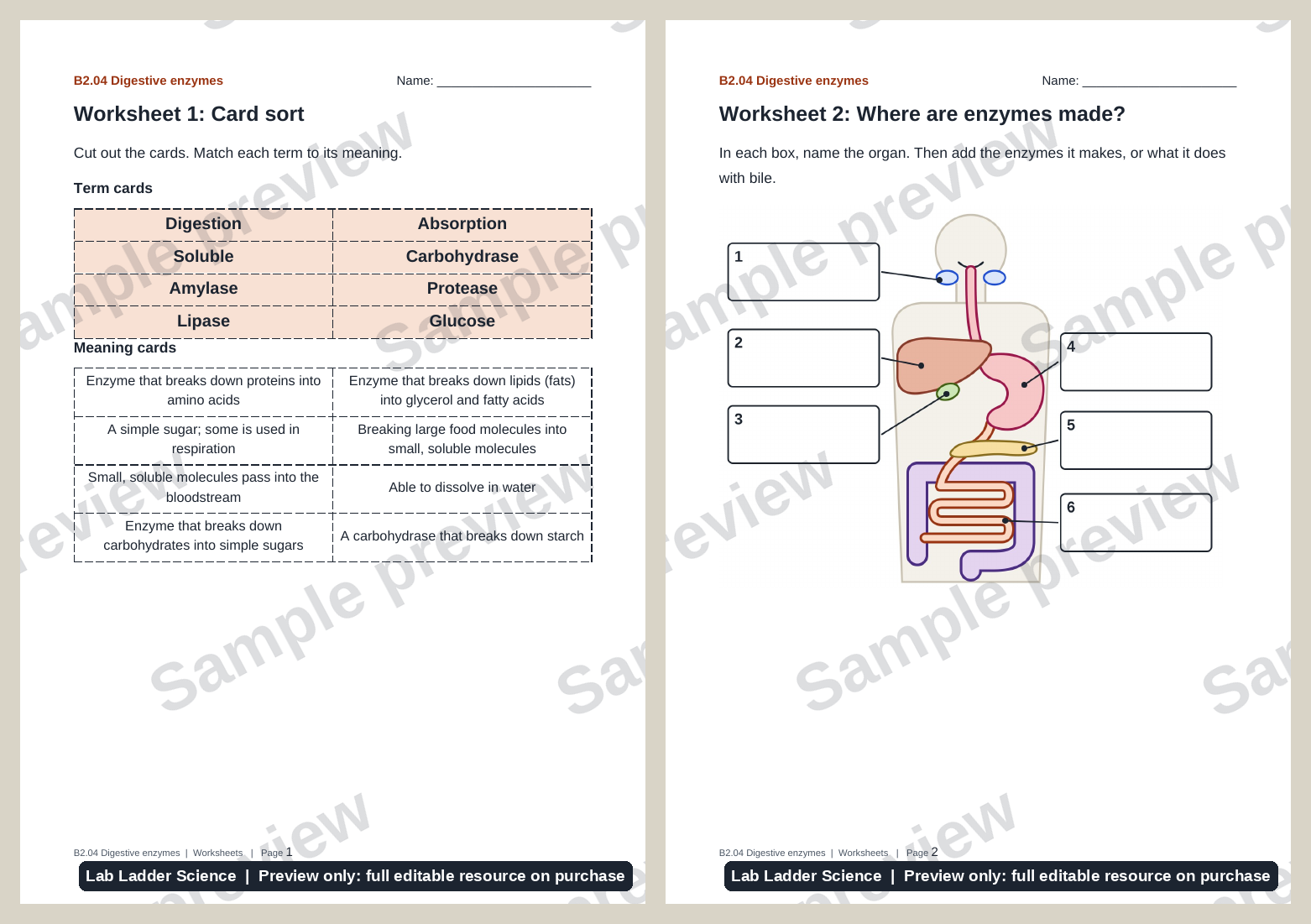
• Editable Word worksheets: a key terms card sort, a digestive system labelling sheet (core and support versions), a digestive enzymes summary table, and exam-style questions on a bile and lipase experiment (core and support versions) with a full mark scheme in the notes.
• Word lesson plan with objectives, lesson sequence, differentiation, answers and common misconceptions.
Lesson outline
• Starter (5 min): What did a hole in one man’s stomach teach us about digestion?
• Activity 1 (13 min): Why food is digested, the three types of digestive enzyme and their products, and a key terms card sort.
• Activity 2 (15 min): Label where amylase, proteases, lipases and bile are made, then complete a summary table.
• Activity 3 (17 min): How bile emulsifies fat and neutralises acid, different optimum pH values, and exam-style questions on a lipase experiment.
• Plenary (8 min): Exit ticket at three levels, then self-assessment against the objectives.
Differentiation and inclusion
Every activity offers support and stretch that all students can choose, so no one is singled out. Support includes clue words, sentence starters, a word bank, first-letter hints on the labelling sheet and hinted exam questions. Stretch tasks ask students to explain why a second carbohydrase is needed to digest maltose, why starch digestion stops in the stomach and starts again in the small intestine, and to evaluate washing-up liquid as a model for bile.
The slides follow the British Dyslexia Association Style Guide: a clear sans serif font at a large size, a soft cream background, bold (not italics) for emphasis, left-aligned text and plain English. Diagrams use text labels rather than colour alone, the pH graph uses different markers and line styles, levels of challenge never rely on colour, every slide has a proper title for screen readers, and every diagram has alt text. Teacher notes include guidance on discussing food and eating sensitively.
How you could use it
• Teach it after lessons on the digestive system and enzymes, and before the food tests required practical.
• Use it as a ready-made cover lesson: the teacher notes explain every step, and the demonstration is optional.
• Use the card sort, labelling sheet and summary table for retrieval practice before mocks.
• Use the exam-style questions for homework or revision of bile, lipase and rate calculations.
Specification coverage
AQA GCSE Biology 8461, section 4.2.2.1 The human digestive system: digestive enzymes convert food into small soluble molecules; carbohydrases, proteases and lipases, their substrates, products and sites of production; the uses of the products of digestion; and bile, including neutralising stomach acid and emulsifying fat to increase surface area. Key words: digestion, soluble, carbohydrase, amylase, protease, lipase, amino acids, glycerol, fatty acids, bile, emulsify. The previous lesson in the series is B2.03 Required practical: pH and amylase, and the next is B2.05 Required practical: food tests.
You must log in and be a buyer of this download to submit a review.