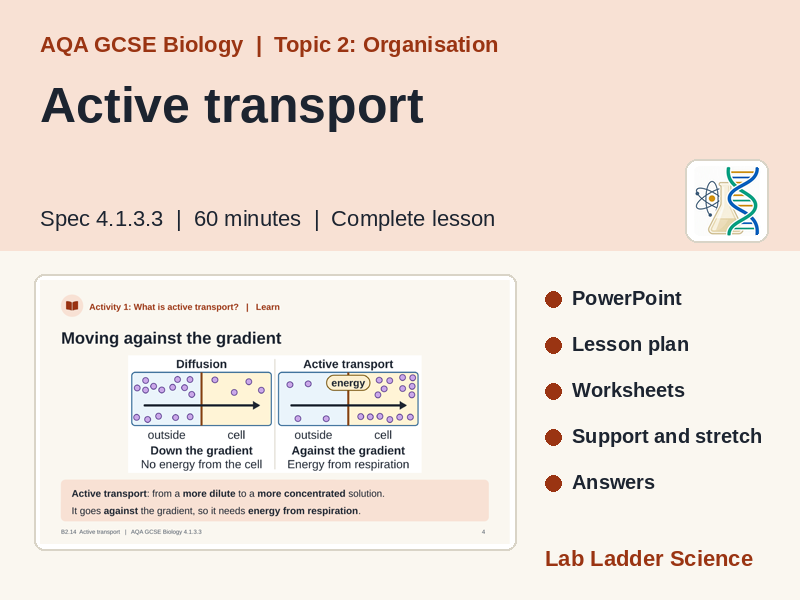
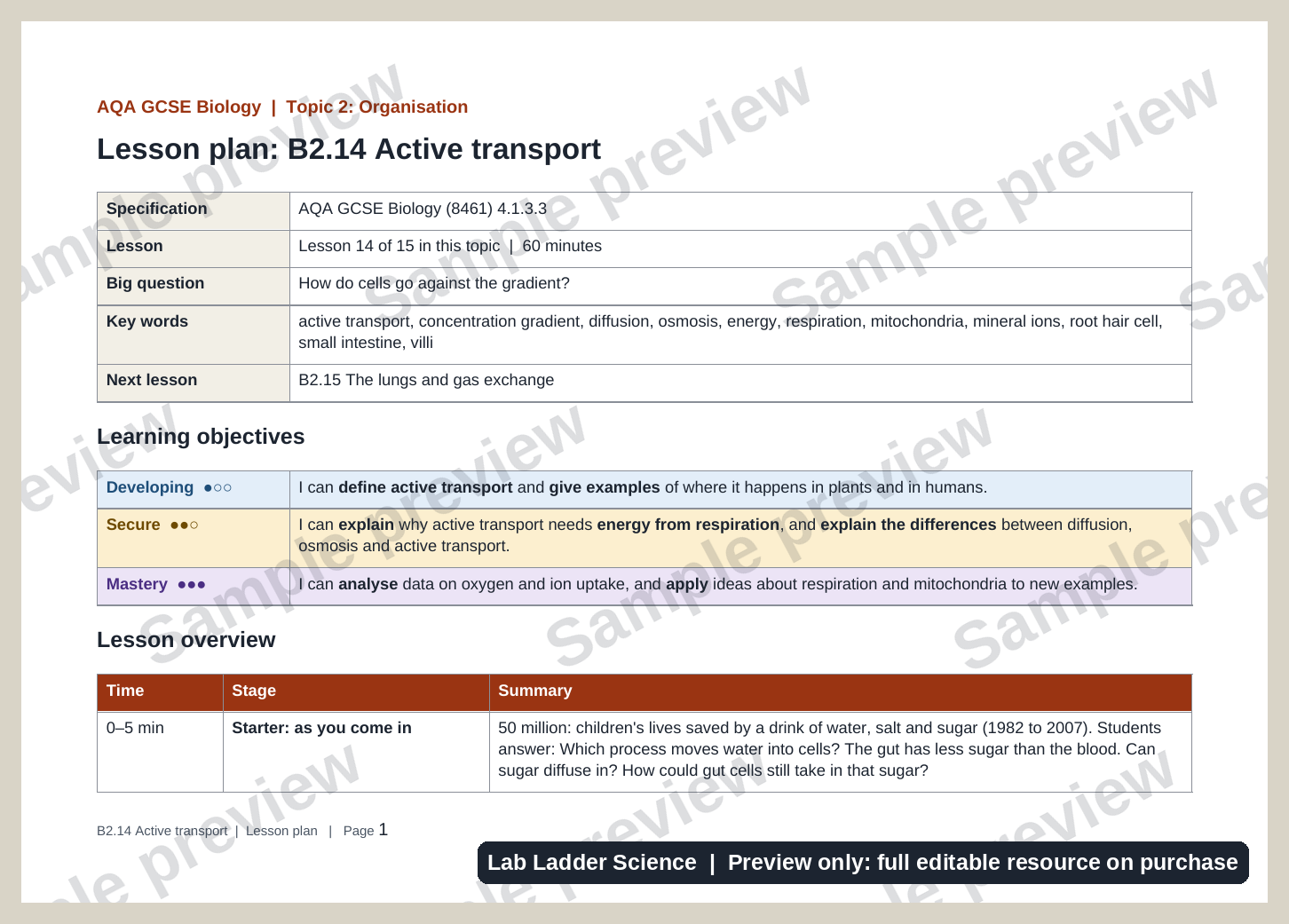
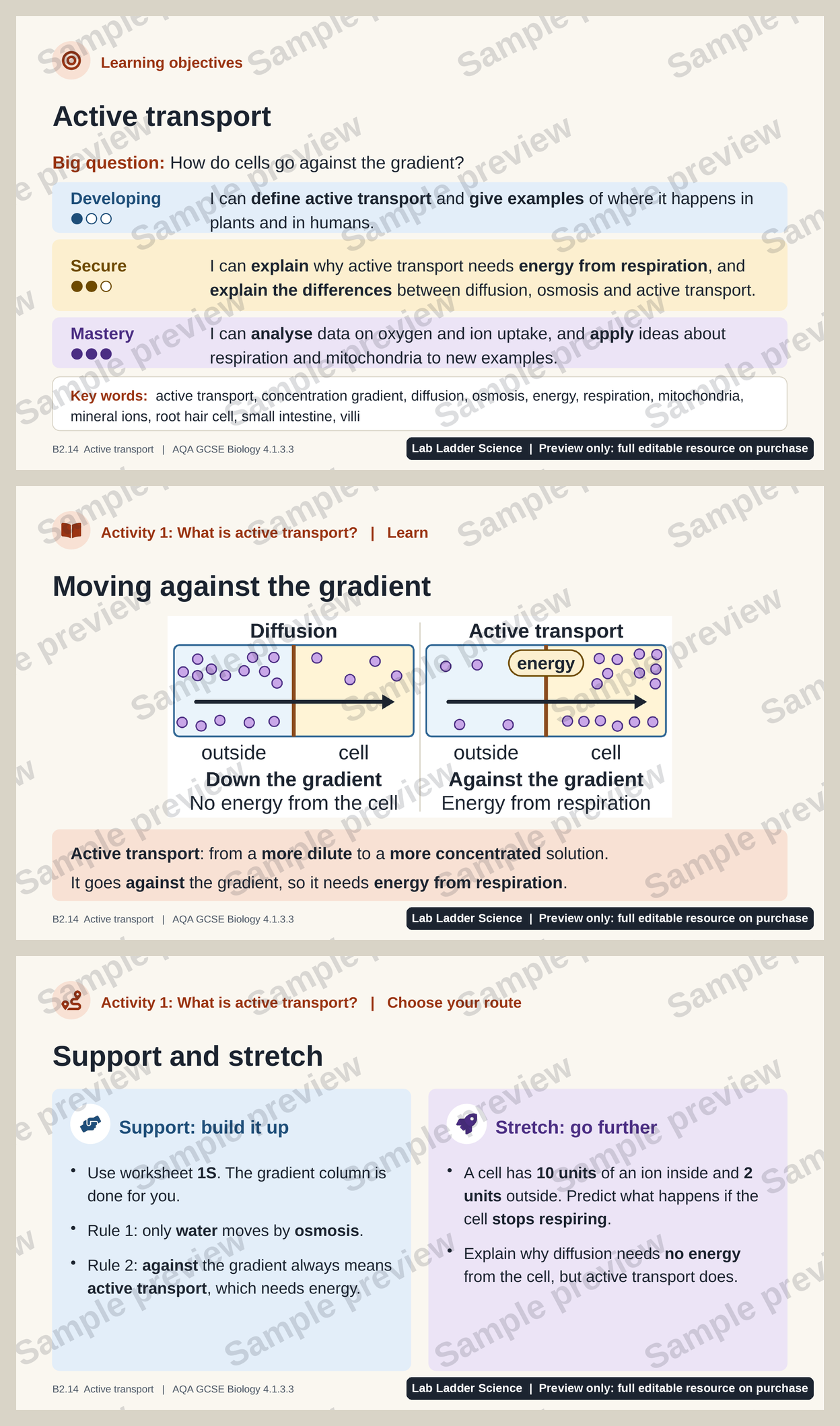
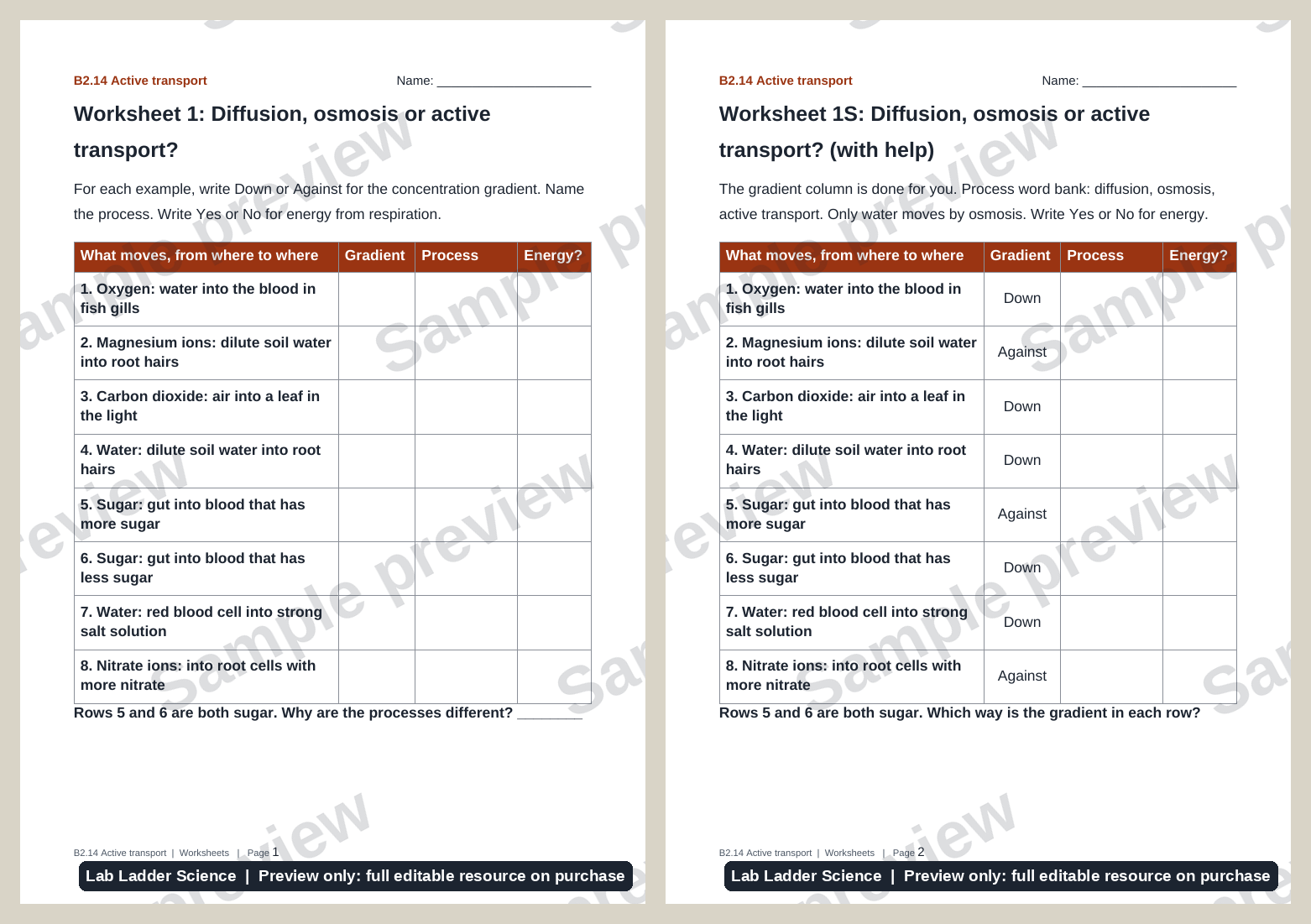
Active transport lesson for AQA GCSE Biology 4.1.3.3: root hair cells, sugar absorption in the gut, comparing diffusion, osmosis and active transport.
What is this resource?
This is a complete lesson on active transport for AQA GCSE Biology (8461), covering specification point 4.1.3.3. It is Lesson 14 of 14 in Topic 2: Organisation, is designed to last 60 minutes, and ties together transport in cells from Topic 1 with plant and human organ systems from Topic 2.
Students recap diffusion and osmosis, then learn that active transport moves substances from a more dilute solution to a more concentrated solution, against the concentration gradient, using energy from respiration. A comparison table of the three processes comes early, so every student meets it. Students then apply the idea to root hair cells absorbing mineral ions from very dilute soil water and to the small intestine absorbing sugar into the blood, and finish by analysing a graph of oxygen and ion uptake to explain the link between oxygen, respiration, mitochondria and active transport.
What’s included
• PowerPoint lesson (33 slides) with full teacher notes on every slide: timings, answers, mark schemes, misconceptions and questioning prompts.
• Starter on screen as students arrive, based on a real-world hook: oral rehydration solution, a simple drink of water, salt and sugar estimated to have saved more than 50 million children’s lives.
• Learning objectives at three levels of challenge: Developing, Secure and Mastery.
• Three learning activities, each with a core task, a support option, a stretch task and a ‘stand back’ mini-whiteboard check with answers.
• Clear original diagrams: diffusion and active transport side by side, a root hair cell taking in mineral ions and water, sugar absorption across the lining of the small intestine, and a line graph of ion uptake at different oxygen levels.
• Comparison table of diffusion, osmosis and active transport on a slide, ready for revision.
• Plenary exit ticket with one question per level, an answers slide for self-assessment and a return to the starter.
• Editable Word worksheets: a diffusion, osmosis or active transport sorting table (core and support versions), questions on active transport in plants and humans, exam-style questions on an investigation (core and support versions, with a full mark scheme in the notes), and a comparison table for homework.
• Word lesson plan with objectives, lesson sequence, an optional seedling investigation, differentiation, answers and common misconceptions.
Lesson outline
• Starter (5 min): How can a drink of salt, sugar and water save lives?
• Activity 1 (15 min): Compare diffusion, osmosis and active transport, then decide whether eight examples are diffusion, osmosis or active transport.
• Activity 2 (15 min): Explain how root hair cells absorb mineral ions and how the small intestine absorbs sugar, and why these cells have many mitochondria.
• Activity 3 (15 min): Analyse a graph of oxygen and ion uptake, then answer exam-style questions on an investigation with seedlings.
• Plenary (8 min): Exit ticket at three levels, self-assessment against the objectives and a return to the starter.
Differentiation and inclusion
Every activity offers support and stretch that all students can choose, so no one is singled out. Support includes a part-completed sorting table, simple rules for telling the processes apart, sketching prompts, sentence starters and an exam-style question sheet with hints. Stretch tasks ask students to predict what happens when a cell stops respiring, explain why sugar is absorbed by diffusion and then by active transport, explain why plants in waterlogged soil turn yellow, and suggest why some kidney cells are packed with mitochondria.
The slides follow the British Dyslexia Association Style Guide: a clear sans serif font at a large size, a soft cream background, bold (not italics) for emphasis, left-aligned text and plain English. Diagrams use shapes and labels rather than colour alone, levels of challenge never rely on colour, every slide has a proper title for screen readers, and every diagram has alt text. The starter includes a teacher note on handling illness and dehydration sensitively.
How you could use it
• Teach it as a full lesson on active transport after diffusion, osmosis and plant transport.
• Use it to finish Topic 2 with a lesson that links cell biology to plant and human organ systems.
• Use it as a ready-made cover lesson: the teacher notes explain every step and give all the answers.
• Use the comparison table, sorting activity and exam-style questions for revision of diffusion, osmosis and active transport before mocks.
Specification coverage
AQA GCSE Biology 8461, section 4.1.3.3 Active transport, including movement against a concentration gradient using energy from respiration, the absorption of mineral ions into root hairs from very dilute solutions in the soil, the absorption of sugar from lower concentrations in the gut into the blood, and describing and explaining the differences between diffusion, osmosis and active transport. Key words: active transport, concentration gradient, diffusion, osmosis, energy, respiration, mitochondria, mineral ions, root hair cell, small intestine, villi. The previous lesson in the series is B2.13 Transpiration and translocation, and the next is B3.01 Communicable diseases.
You must log in and be a buyer of this download to submit a review.