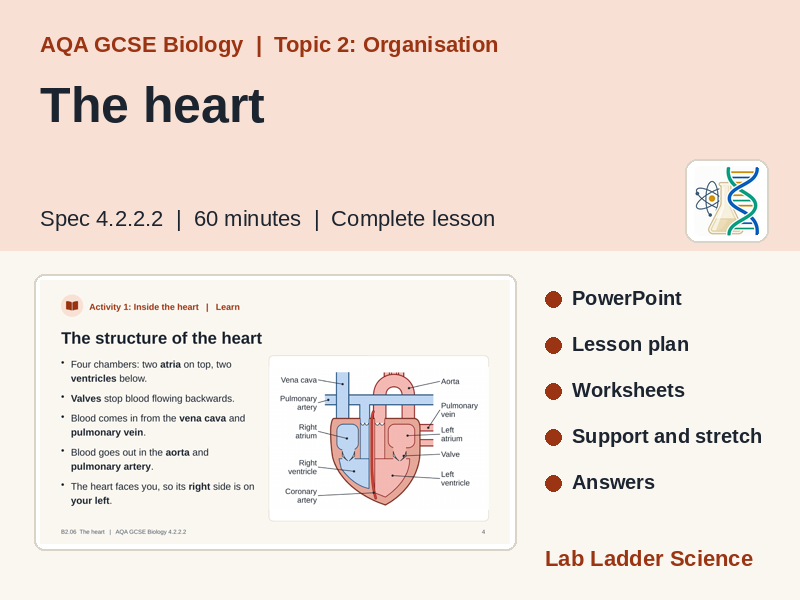
The heart lesson for AQA GCSE Biology 4.2.2.2: heart structure, double circulatory system, pacemaker cells and artificial pacemakers, worksheets, answers.
What is this resource?
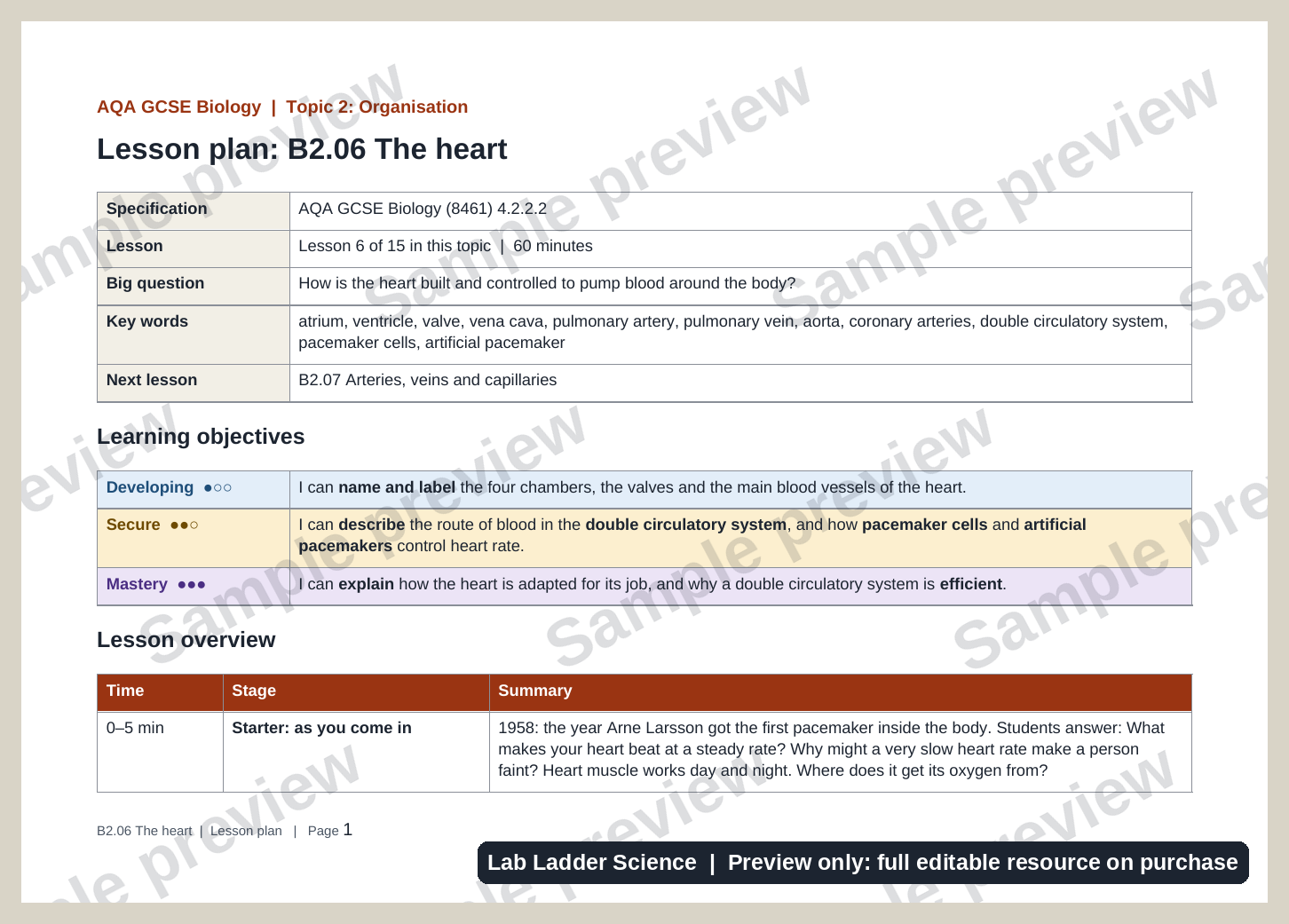
This is a complete lesson on the heart for AQA GCSE Biology (8461), covering the heart content of specification point 4.2.2.2. It is Lesson 6 of 14 in Topic 2: Organisation and is designed to last 60 minutes.
Students learn the four chambers, the valves and the blood vessels joined to the heart: the aorta, vena cava, pulmonary artery, pulmonary vein and coronary arteries. They follow the route of blood through the double circulatory system, explain why a double pump is efficient, and find out how pacemaker cells in the right atrium and artificial pacemakers control the heart rate. Blood vessels are taught in the next lesson.
What’s included
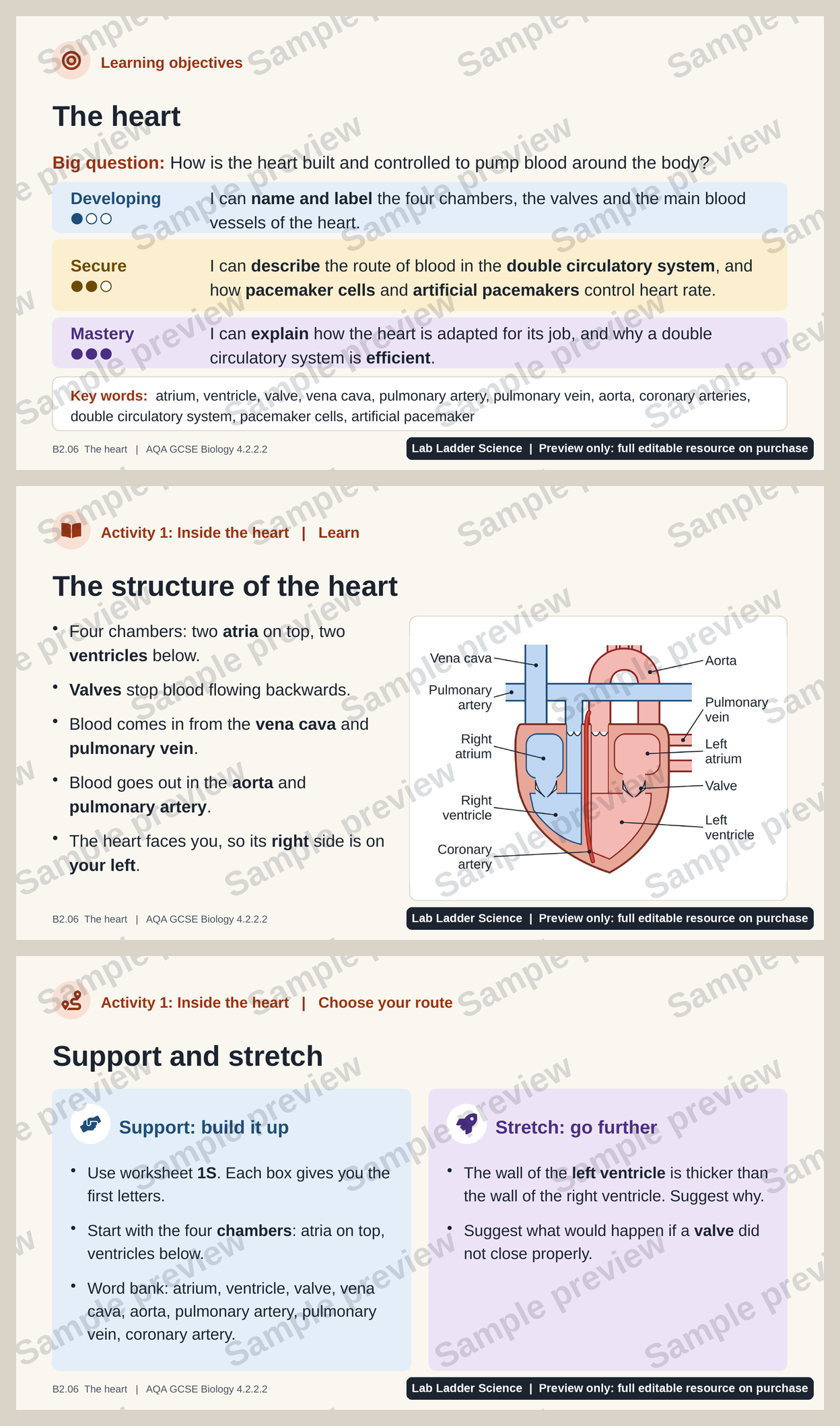
• PowerPoint lesson (32 slides) with full teacher notes on every slide: timings, answers, a mark scheme, misconceptions, questioning prompts and guidance on handling heart conditions sensitively.
• Starter on screen as students arrive, based on a real-world hook: Arne Larsson, the first person to have a pacemaker implanted, in 1958.
• Learning objectives at three levels of challenge: Developing, Secure and Mastery.
• Three learning activities: inside the heart, the double pump, and pacemakers. Each has a core task, a support option, a stretch task and a ‘stand back’ mini-whiteboard check with answers.
• Clear original diagrams: a labelled heart, the double circulatory system with dashed and solid lines and a key, the heart’s natural pacemaker, and an artificial pacemaker.
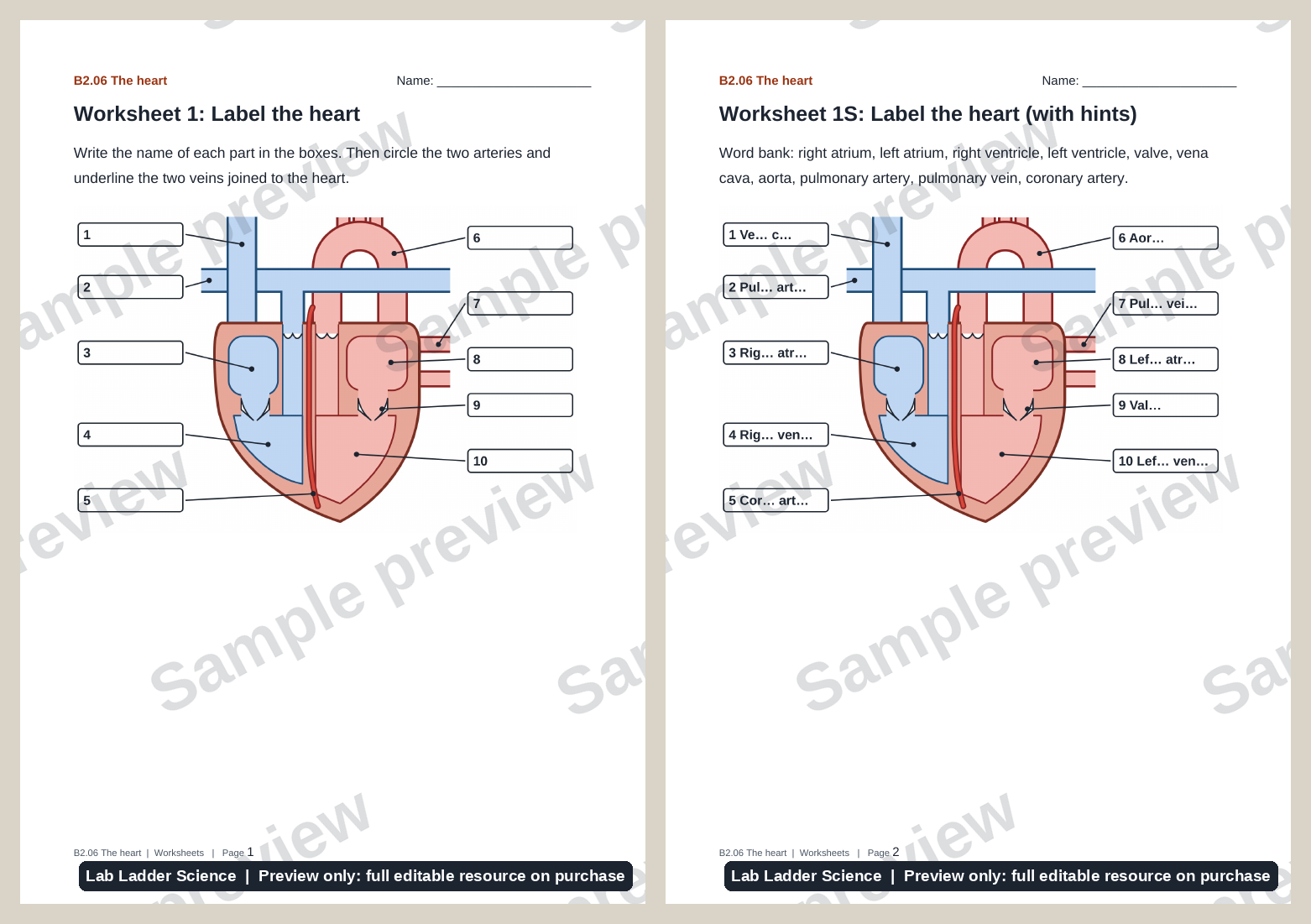
• Editable Word worksheets: label the heart (core and first-letter hint versions), a card sort matching each part to its job, a follow-the-blood route table (core and support versions), and seven exam-style questions including a heart rate calculation, with a full mark scheme in the notes.
• Plenary exit ticket with one question per level, an answers slide for self-assessment and a return to the starter.
• Word lesson plan with objectives, lesson sequence, differentiation, answers and common misconceptions.
Lesson outline
• Starter (5 min): What makes a heart beat, and how did a pacemaker help Arne Larsson in 1958?
• Activity 1 (15 min): Label the chambers, valves and blood vessels of the heart, and learn the job of each part, including the coronary arteries.
• Activity 2 (15 min): Card sort and route table to follow blood through the heart, lungs and body, then explain why a double circulatory system is efficient.
• Activity 3 (15 min): Learn how pacemaker cells and artificial pacemakers control heart rate, then answer exam-style questions.
• Plenary (8 min): Exit ticket at three levels, then self-assessment against the objectives.
Differentiation and inclusion
Every activity offers support and stretch that all students can choose, so no one is singled out. Support includes a first-letter hint labelling sheet, word banks, a part-completed route table, sentence starters and a maths tip. Stretch tasks ask students to explain the thick left ventricle wall, compare single and double circulation in fish, explain why the pulmonary artery is an artery, and suggest the advantages of modern pacemakers.
The slides follow the British Dyslexia Association Style Guide: a clear sans serif font at a large size, a soft cream background, bold (not italics) for emphasis, left-aligned text and plain English. Oxygenated and deoxygenated blood are shown with words, line styles and a key, not colour alone. Every slide has a proper title for screen readers and every diagram has alt text. Teacher notes give guidance on students with heart conditions and on offering alternatives to heart dissection.
How you could use it
• Teach it as the first lesson on the circulatory system, before arteries, veins and capillaries.
• Pair it with a heart dissection or model heart demonstration; the notes show where it fits.
• Use the labelling sheet, card sort and exam-style questions for retrieval practice before mocks.
• Use it as a ready-made cover lesson: the teacher notes explain every step.
Specification coverage
AQA GCSE Biology 8461, section 4.2.2.2 The heart and blood vessels: the heart as a double pump, its structure, the blood vessels associated with the heart, pacemaker cells and artificial pacemakers. Key words: atrium, ventricle, valve, vena cava, pulmonary artery, pulmonary vein, aorta, coronary arteries, double circulatory system, oxygenated, deoxygenated, pacemaker cells, artificial pacemaker. The previous lesson in the series is B2.05 Required practical: food tests, and the next is B2.07 Arteries, veins and capillaries.
You must log in and be a buyer of this download to submit a review.