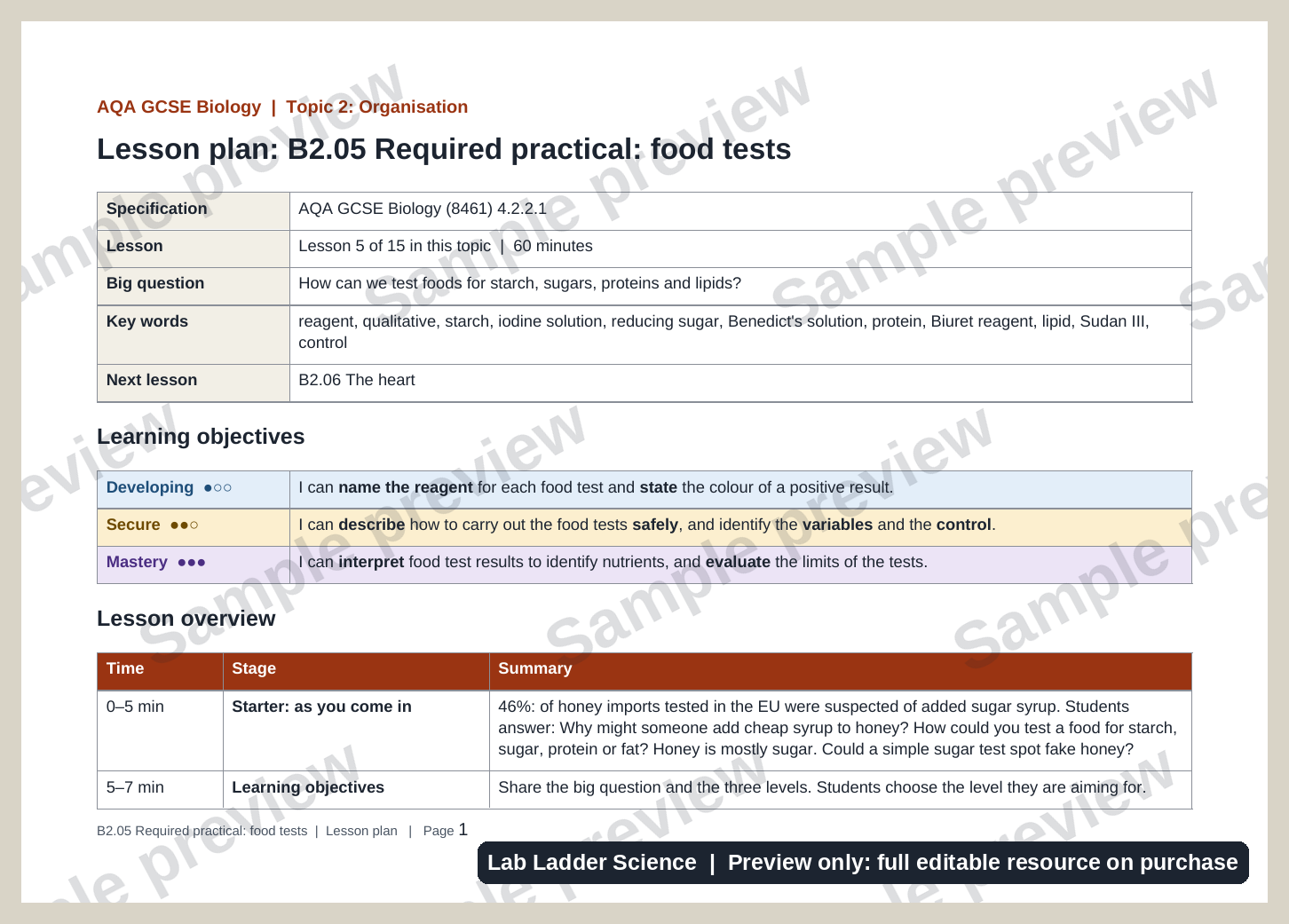
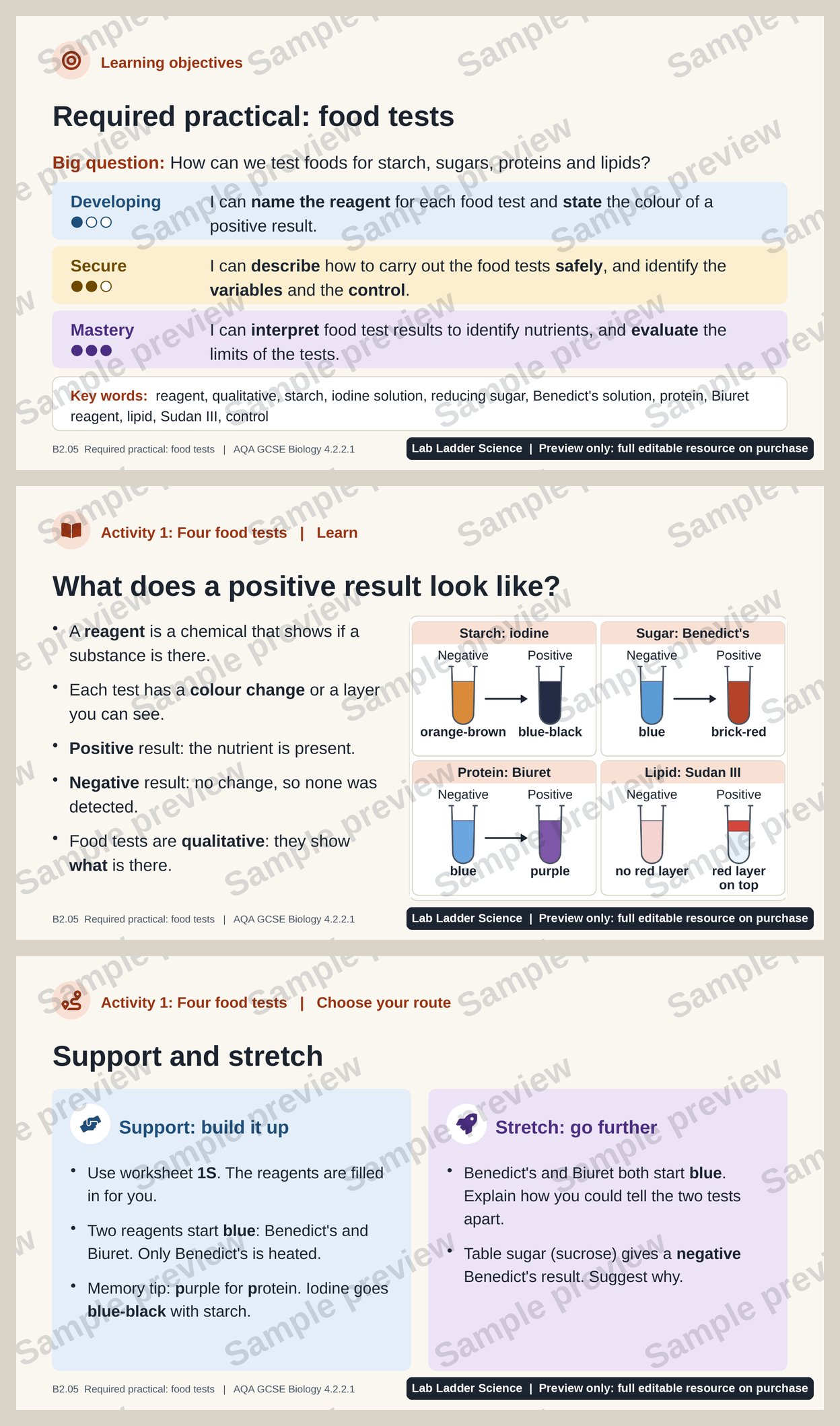
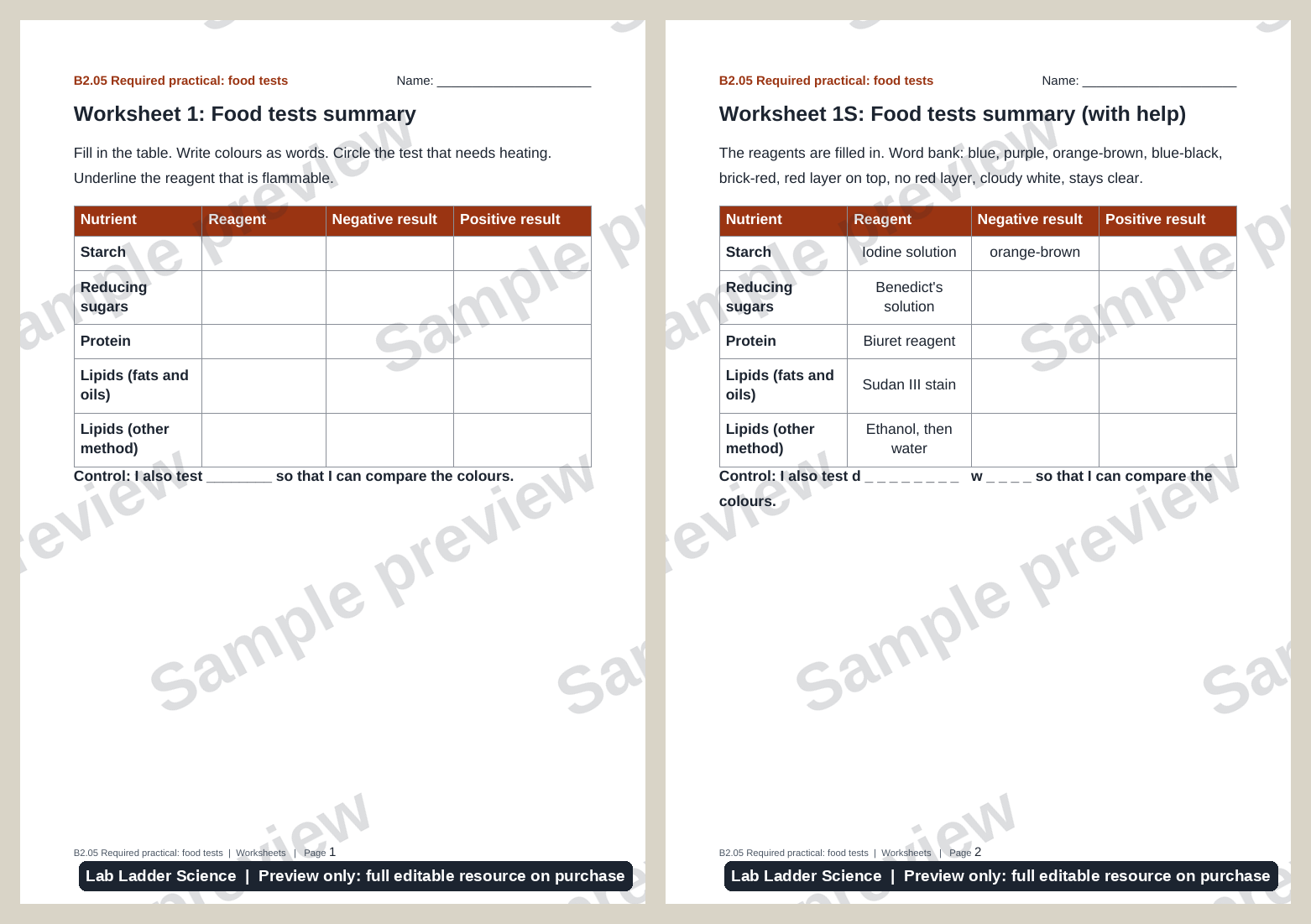
Food tests required practical lesson for AQA GCSE Biology 4.2.2.1: Benedict’s, iodine, Biuret and Sudan III tests, results table, worksheets and answers.
What is this resource?
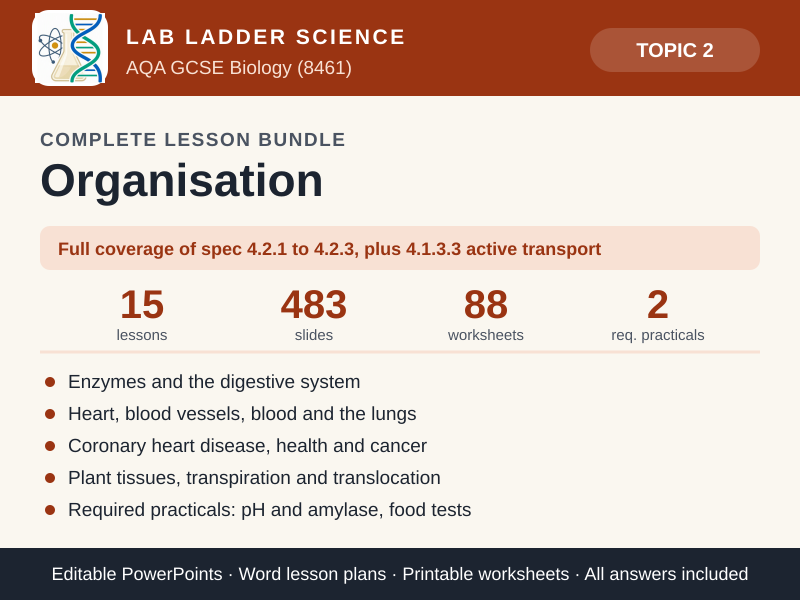
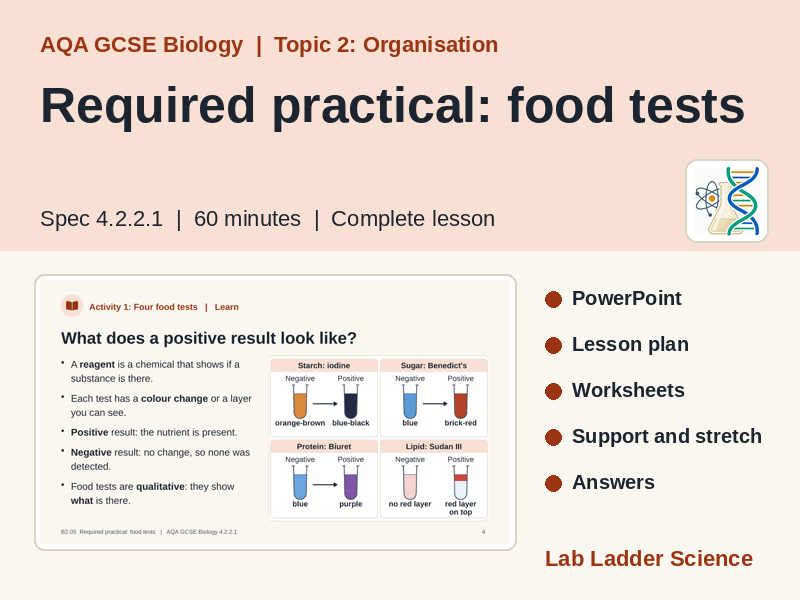
This is a complete lesson on the food tests required practical for AQA GCSE Biology (8461), covering specification point 4.2.2.1 and Required practical activity 4: use qualitative reagents to test for a range of carbohydrates, lipids and proteins. It is Lesson 5 of 14 in Topic 2: Organisation and is designed to last 60 minutes.
Students learn the iodine test for starch, Benedict’s test for reducing sugars, the Biuret test for protein and the Sudan III test for lipids, with the ethanol emulsion test as an alternative. They carry out the tests safely using distilled water as a control, then interpret a realistic set of sample results to identify the nutrients in unknown foods. The sample data means the analysis works even if class results are unclear or you run the practical as a demonstration.
What’s included
• PowerPoint lesson (32 slides) with full teacher notes on every slide: timings, equipment list, amounts of reagents, safety, expected results, answers, a mark scheme and misconceptions.
• Starter on screen as students arrive, based on a real-world hook: nearly half of the honey imports tested in the EU were suspected of being mixed with cheap sugar syrup.
• Learning objectives at three levels of challenge: Developing, Secure and Mastery.
• Three learning activities: learn the four food tests, carry out the practical, and analyse results. Each has a core task, a support option, a stretch task and a ‘stand back’ mini-whiteboard check with answers.
• Required practical essentials: aim, equipment, independent, dependent and control variables, hazards and safety, a step-by-step method with an apparatus diagram, a results table and evaluation of the tests.
• Clear diagrams of positive and negative results for each test and a Benedict’s colour scale. Every colour is written as a word, so no information relies on colour alone.
• Editable Word worksheets: a food tests summary table (core and support versions), a class results table, a sample results analysis sheet (core and support versions) and eight exam-style questions with a full mark scheme in the notes.
• Plenary exit ticket with one question per level, an answers slide for self-assessment and a return to the starter.
• Word lesson plan with objectives, lesson sequence, equipment, safety, differentiation, answers and common misconceptions.
Lesson outline
• Starter (5 min): Could a simple sugar test catch fake honey?
• Activity 1 (10 min): Learn the reagent and the positive result for starch, reducing sugars, protein and lipids, then build a summary table from memory.
• Activity 2 (20 min): Plan the practical with variables and hazards, then carry out the four food tests on several foods and a distilled water control.
• Activity 3 (15 min): Use the Benedict’s colour scale, analyse Leon’s results to identify nutrients, and answer exam-style questions on method and evaluation.
• Plenary (8 min): Exit ticket at three levels, then self-assessment against the objectives.
Differentiation and inclusion
Every activity offers support and stretch that all students can choose, so no one is singled out. Support includes a part-completed summary table with a word bank, paired roles for the practical, a key to positive results and sentence starters. Stretch tasks ask students to explain why sucrose gives a negative Benedict’s result, why the lipid test is not filtered, how to make the Benedict’s test more precise and how the results identify milk.
The slides follow the British Dyslexia Association Style Guide: a clear sans serif font at a large size, a soft cream background, bold (not italics) for emphasis, left-aligned text and plain English. Colour changes are always written as words, levels of challenge never rely on colour, every slide has a proper title for screen readers, and every diagram has alt text. Teacher notes include guidance on food allergies and on students who prefer not to handle certain foods.
How you could use it
• Teach it after a lesson on digestive enzymes to complete the food tests required practical.
• Run the practical as a class investigation or a demonstration, and use Leon’s sample results for the analysis.
• Use the summary table and exam-style questions for required practical revision before mocks and final exams.
• Use it as a cover lesson with the practical removed: the summary, analysis and question worksheets stand on their own.
Specification coverage
AQA GCSE Biology 8461, section 4.2.2.1 The human digestive system, Required practical activity 4: food tests. Key words: reagent, qualitative, starch, iodine solution, reducing sugar, Benedict’s solution, protein, Biuret reagent, lipid, Sudan III, emulsion test, control, independent variable, dependent variable. The previous lesson in the series is B2.04 Digestive enzymes, and the next is B2.06 The heart.
You must log in and be a buyer of this download to submit a review.