Effect of pH on amylase required practical for AQA GCSE Biology 4.2.2.1: iodine method, variables, rate = 1000/time, graph, worksheets and answers.
What is this resource?
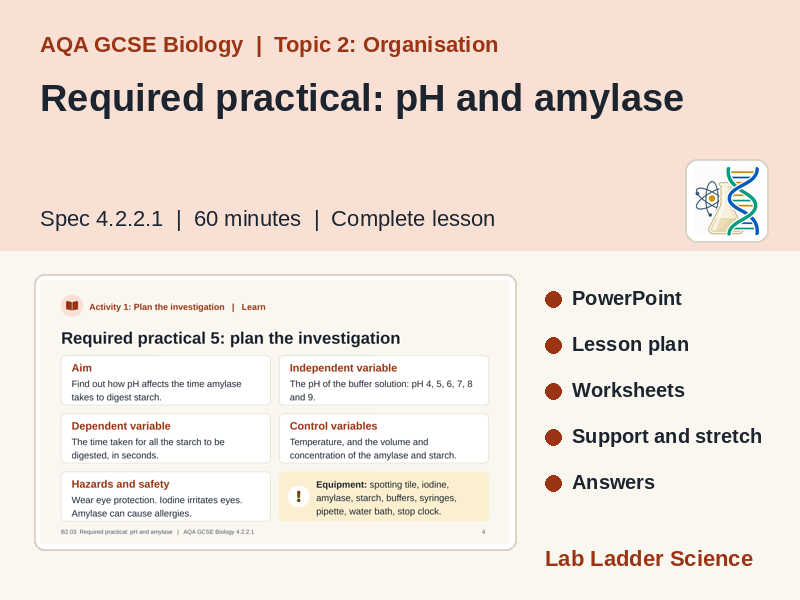
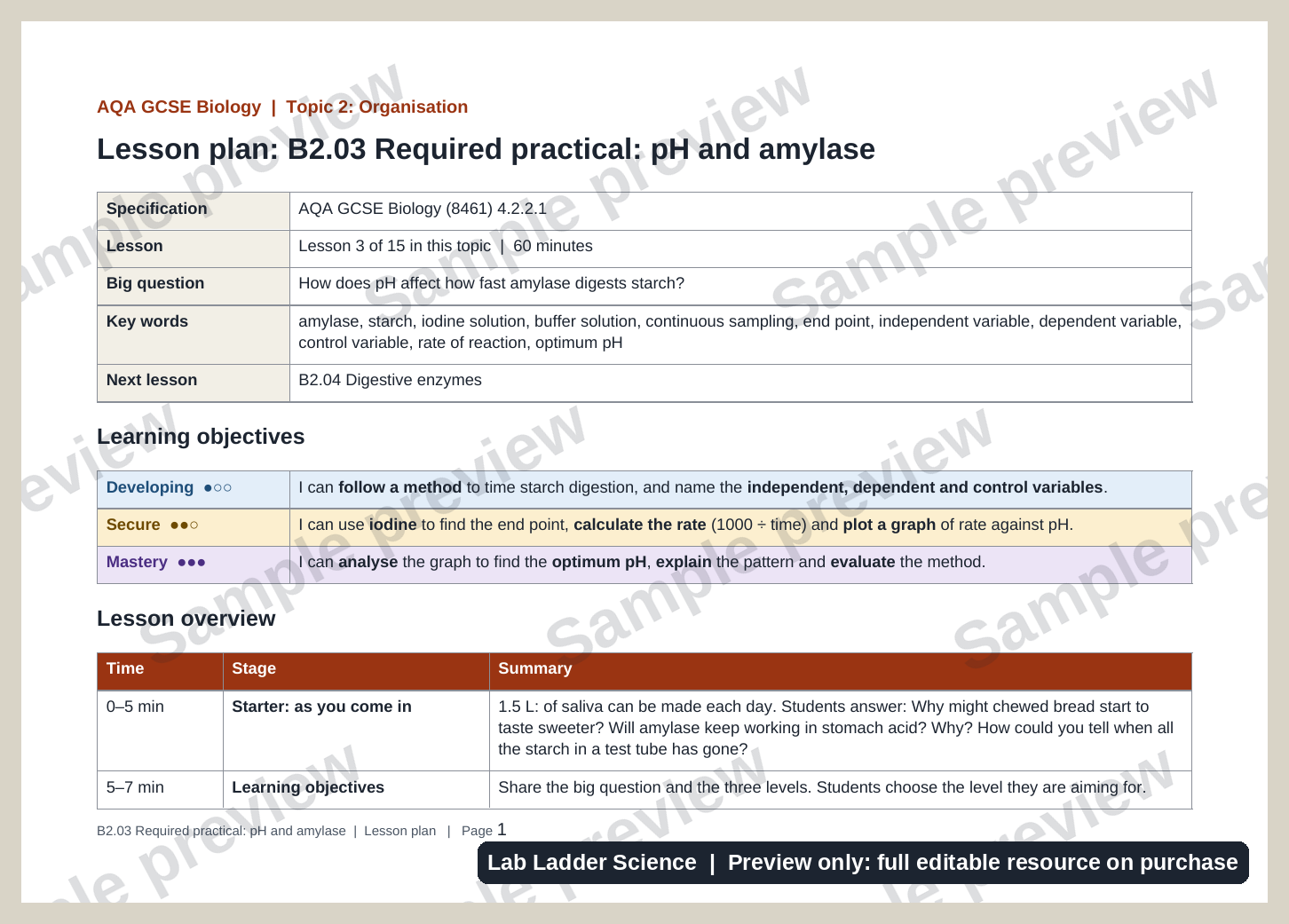
This is a complete lesson on the amylase required practical for AQA GCSE Biology (8461), covering specification point 4.2.2.1 and Required practical activity 5: investigate the effect of pH on the rate of reaction of amylase. It is Lesson 3 of 14 in Topic 2: Organisation and is designed to last 60 minutes.
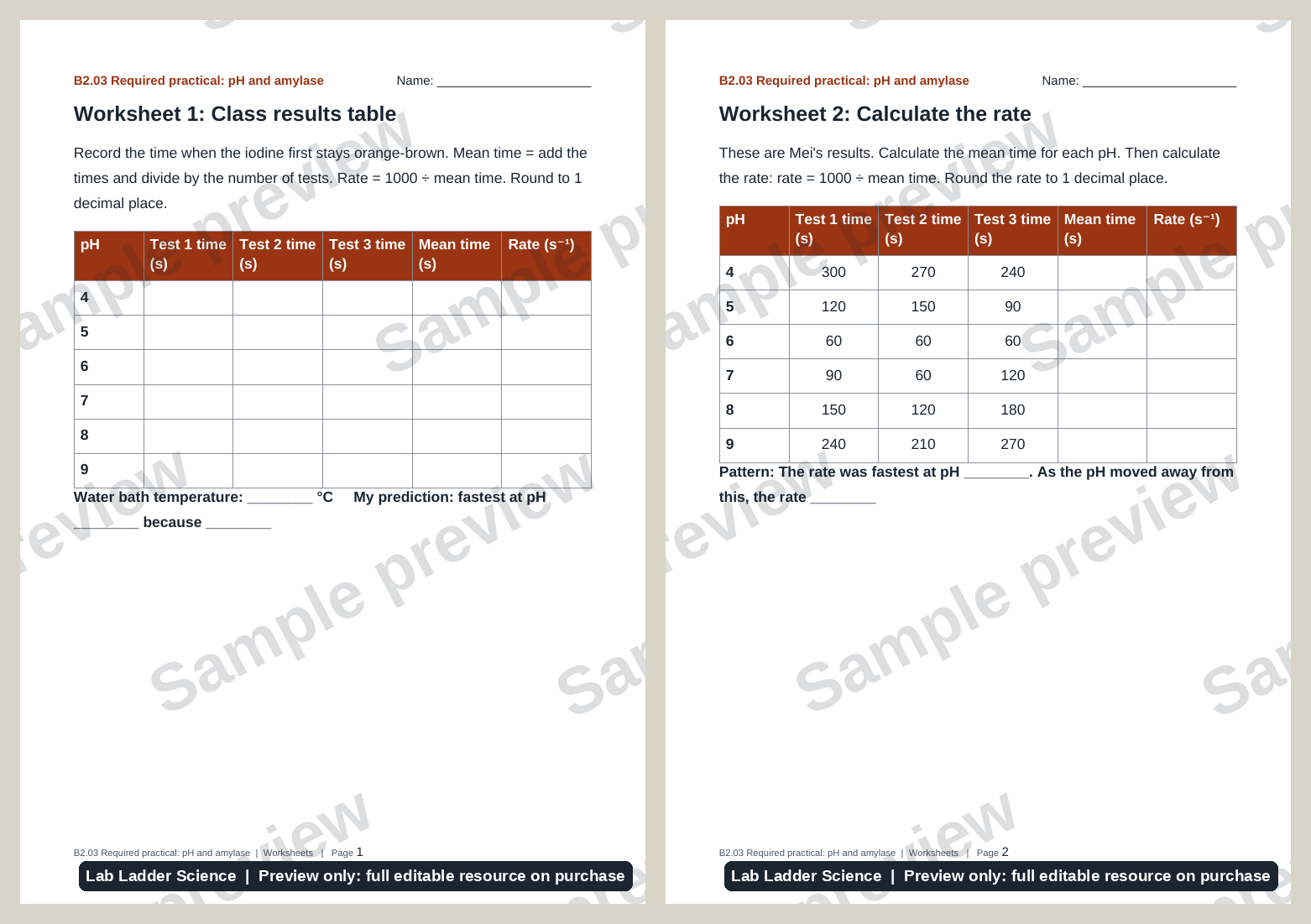
Students plan the investigation, then use continuous sampling with iodine solution on a spotting tile every 30 seconds to time how long amylase takes to digest starch at different pH values, with temperature controlled by a water bath. They calculate the rate of reaction using rate = 1000 ÷ time, plot a graph of rate against pH and use it to find the optimum pH. Realistic sample data is built in, so the calculations and graph work even if class results are unclear or you run the practical as a demonstration.
What’s included
• PowerPoint lesson (32 slides) with full teacher notes on every slide: timings, equipment and technician list, safety, answers, a mark scheme, misconceptions and questioning prompts.
• Starter on screen as students arrive, based on a real-world hook: salivary glands can make up to about 1.5 litres of saliva a day, and its amylase starts digesting starch before food reaches the acid of the stomach.
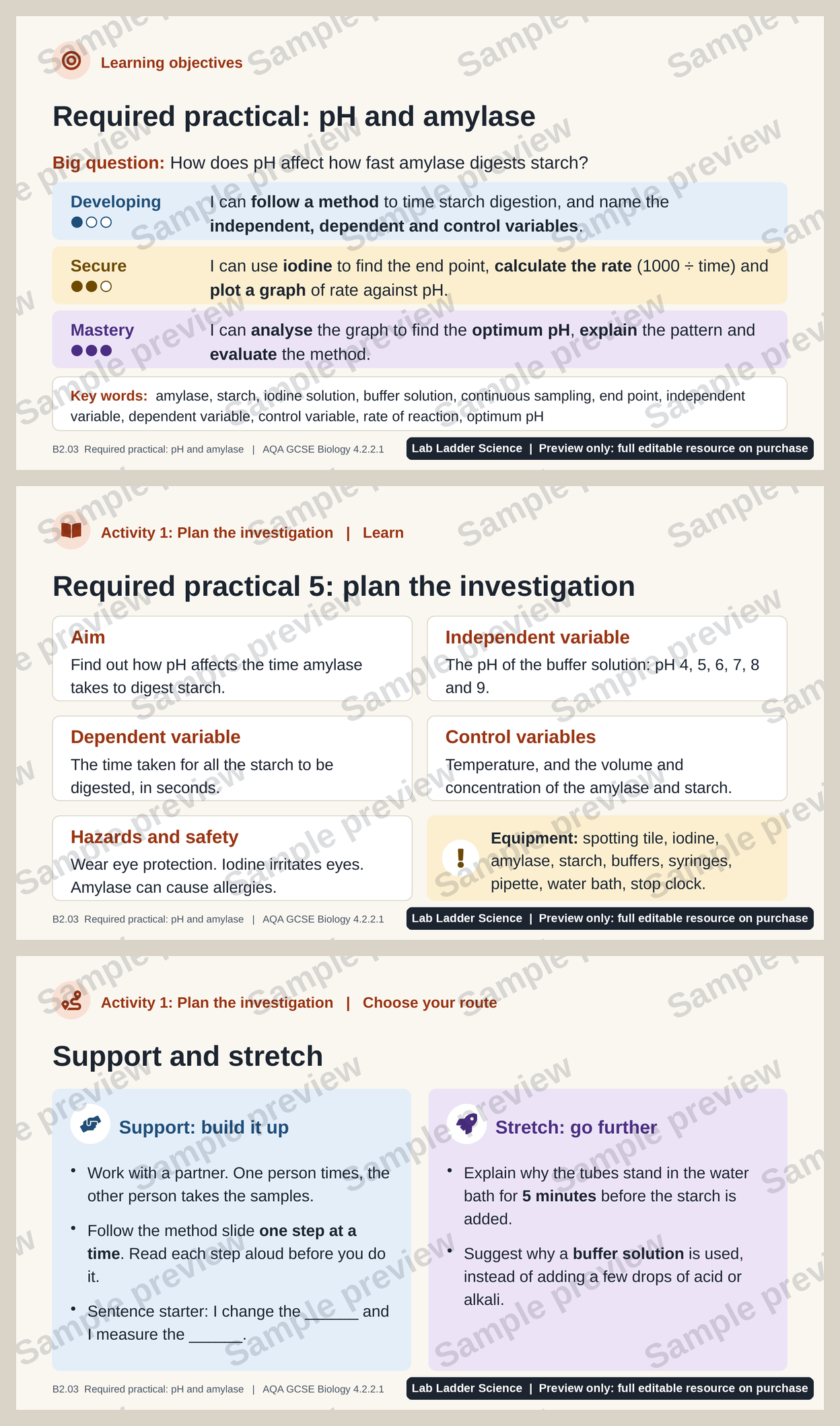
• Learning objectives at three levels of challenge: Developing, Secure and Mastery.
• Three learning activities: plan the investigation, sample every 30 seconds, and calculate the rate and analyse the graph. Each has a core task, a support option, a stretch task and a ‘stand back’ mini-whiteboard check with answers.
• Required practical essentials: aim, equipment, independent, dependent and control variables, hazards and safety, a step-by-step method with an apparatus diagram, a clear spotting tile diagram showing how to find the end point, and a worked example of calculating rate.
• Plenary exit ticket with one question per level, an answers slide for self-assessment and a return to the starter.
• Editable Word worksheets: a class results table, a mean and rate calculation sheet (core and support versions), a graph grid with data (core and support versions), and exam-style analyse and evaluate questions with a full mark scheme in the notes.
• Word lesson plan with objectives, lesson sequence, equipment, safety, differentiation, answers and common misconceptions.
Lesson outline
• Starter (5 min): Why does chewed bread taste sweeter, and does amylase keep working in the stomach?
• Activity 1 (12 min): Identify the variables and hazards, then set up amylase, buffer and starch in a water bath.
• Activity 2 (16 min): Test a drop of the mixture with iodine every 30 seconds, find the end point and share class results.
• Activity 3 (17 min): Calculate mean times and rates, plot rate against pH, find the optimum pH and evaluate the method.
• Plenary (8 min): Exit ticket at three levels, then self-assessment against the objectives.
Differentiation and inclusion
Every activity offers support and stretch that all students can choose, so no one is singled out. Support includes paired roles for the practical, sentence starters, calculator steps, a calculation table with the means done, and a graph grid with scales and the first points already plotted. Stretch tasks ask students to explain why a buffer is used, why the recorded end point may be up to 30 seconds late, and to evaluate a claim about the exact optimum pH.
The slides follow the British Dyslexia Association Style Guide: a clear sans serif font at a large size, a soft cream background, bold (not italics) for emphasis, left-aligned text and plain English. The spotting tile diagram labels every well with words as well as colour, graphs use crosses and labels rather than colour alone, levels of challenge never rely on colour, every slide has a proper title for screen readers, and every diagram has alt text.
How you could use it
• Teach it straight after a lesson on enzymes to complete the amylase required practical.
• Run the practical as a class investigation, sharing pH values between groups, or as a demonstration using the sample data for the analysis.
• Use the rate calculation sheet, graph and exam-style questions for required practical revision before mocks and final exams.
• Use it as a cover lesson with the practical removed: the calculation, graph and question worksheets stand on their own.
Specification coverage
AQA GCSE Biology 8461, section 4.2.2.1 The human digestive system, Required practical activity 5, including rate calculations for enzyme-controlled reactions (MS 1a and 1c) and plotting and interpreting graphs. Key words: amylase, starch, iodine solution, buffer solution, continuous sampling, end point, independent variable, dependent variable, control variable, rate of reaction, optimum pH. The previous lesson in the series is B2.02 Enzymes, and the next is B2.04 Digestive enzymes.
You must log in and be a buyer of this download to submit a review.