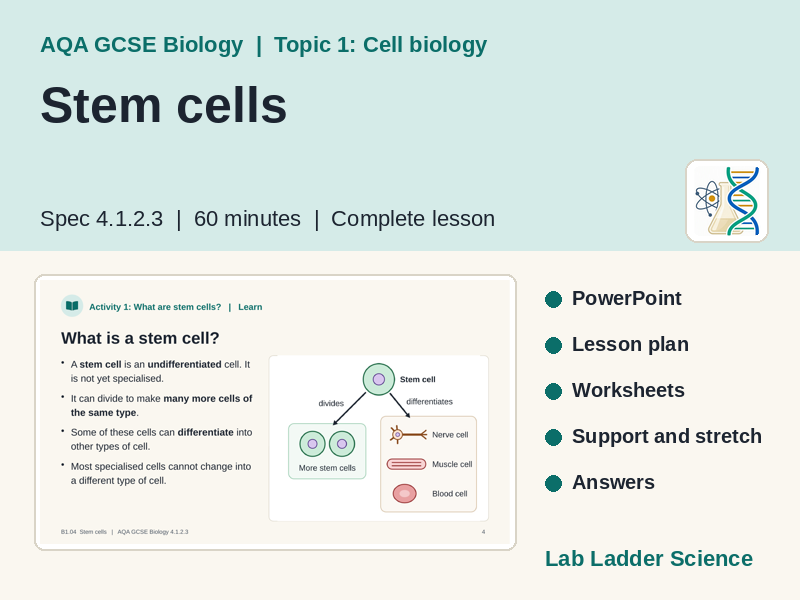
Stem cells lesson for AQA GCSE Biology 4.1.2.3: therapeutic cloning, meristems and ethics. Differentiated PowerPoint, debate, exam questions, answers.
What is this resource?
This is a complete lesson on stem cells for AQA GCSE Biology (8461), covering specification point 4.1.2.3. It is the fourth lesson in Topic 1: Cell biology and is designed to last 60 minutes.
Students learn what a stem cell is and where stem cells are found in embryos, adult bone marrow and plant meristems. They find out how stem cells could help treat conditions such as diabetes and paralysis, how therapeutic cloning avoids rejection, and how meristems are used to clone plants. The lesson ends with a structured debate and a 6-mark evaluation question on the benefits, risks and ethical issues of using embryonic stem cells.
What’s included
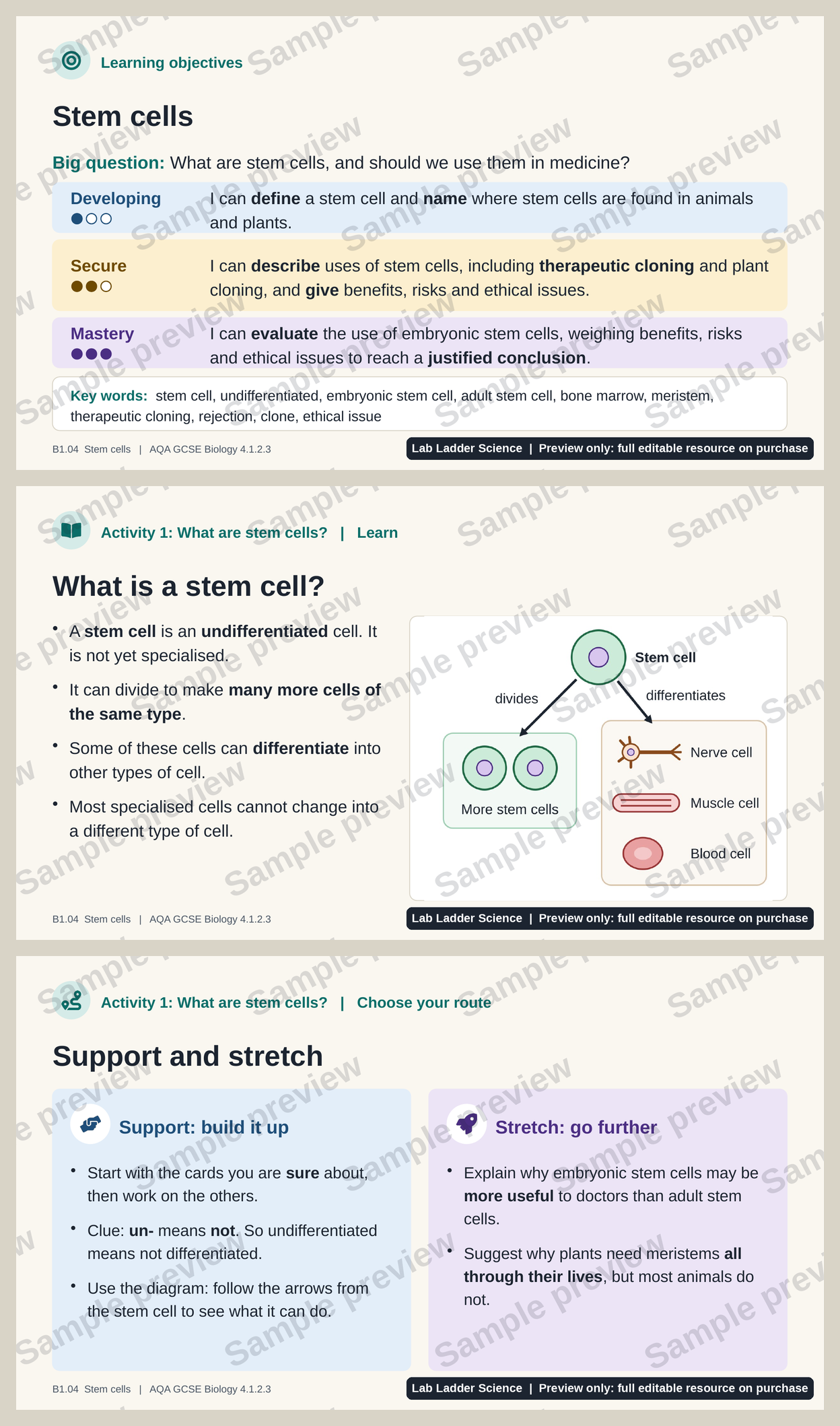
• PowerPoint lesson (33 slides) with full teacher notes on every slide: timings, answers, misconceptions and questioning prompts.
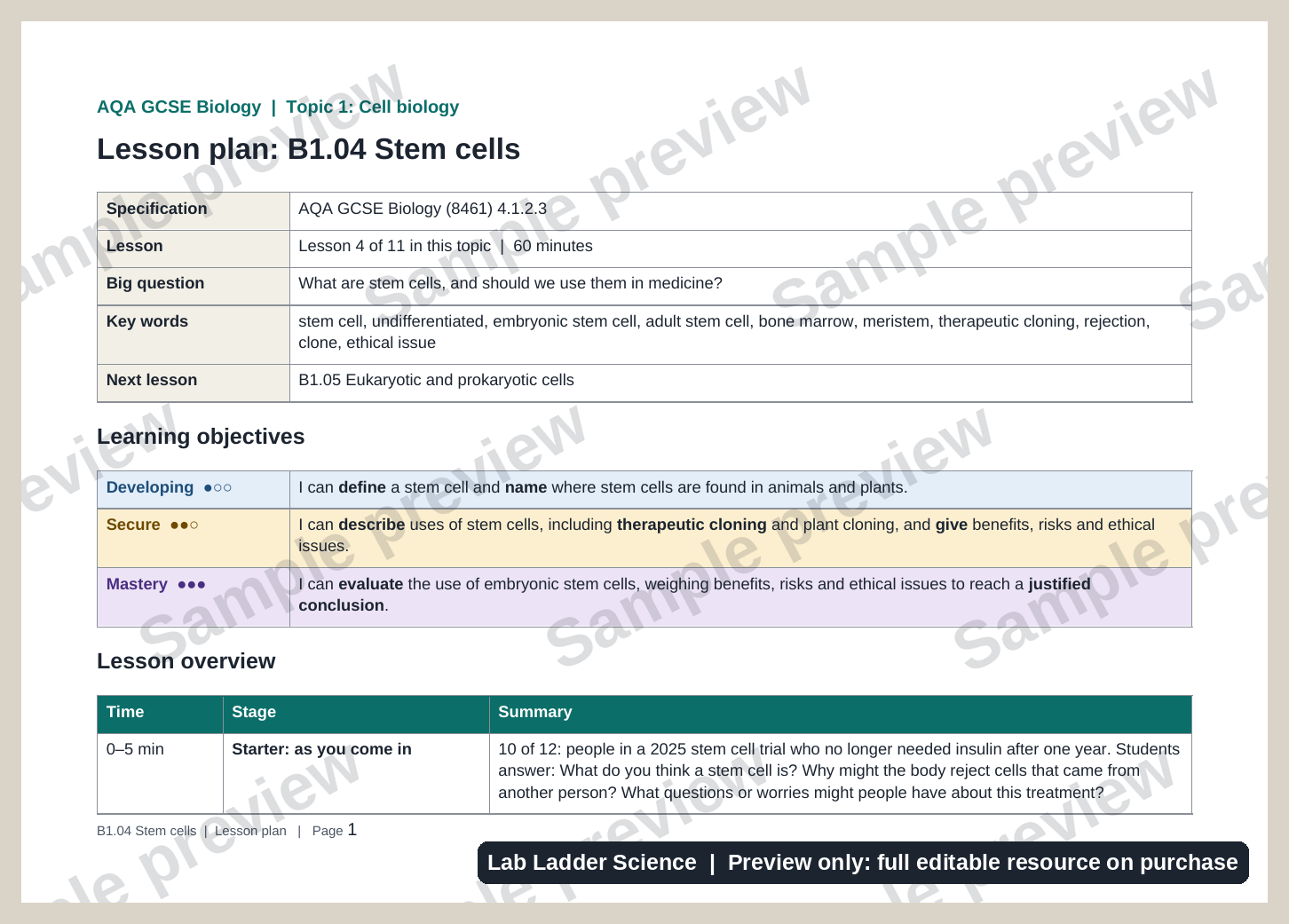
• Starter on screen as students arrive, based on a real-world hook: a 2025 trial in which 10 of 12 people with type 1 diabetes no longer needed insulin after a stem cell treatment.
• Learning objectives at three levels of challenge: Developing, Secure and Mastery.
• Three learning activities, each with a core task, a support option, a stretch task and a ‘stand back’ mini-whiteboard check with answers.
• Plenary exit ticket with one question per level, an answers slide for self-assessment and a return to the starter.
• Clear diagrams showing what a stem cell does, where stem cells are found (embryo, bone marrow, plant meristems) and the steps of therapeutic cloning.
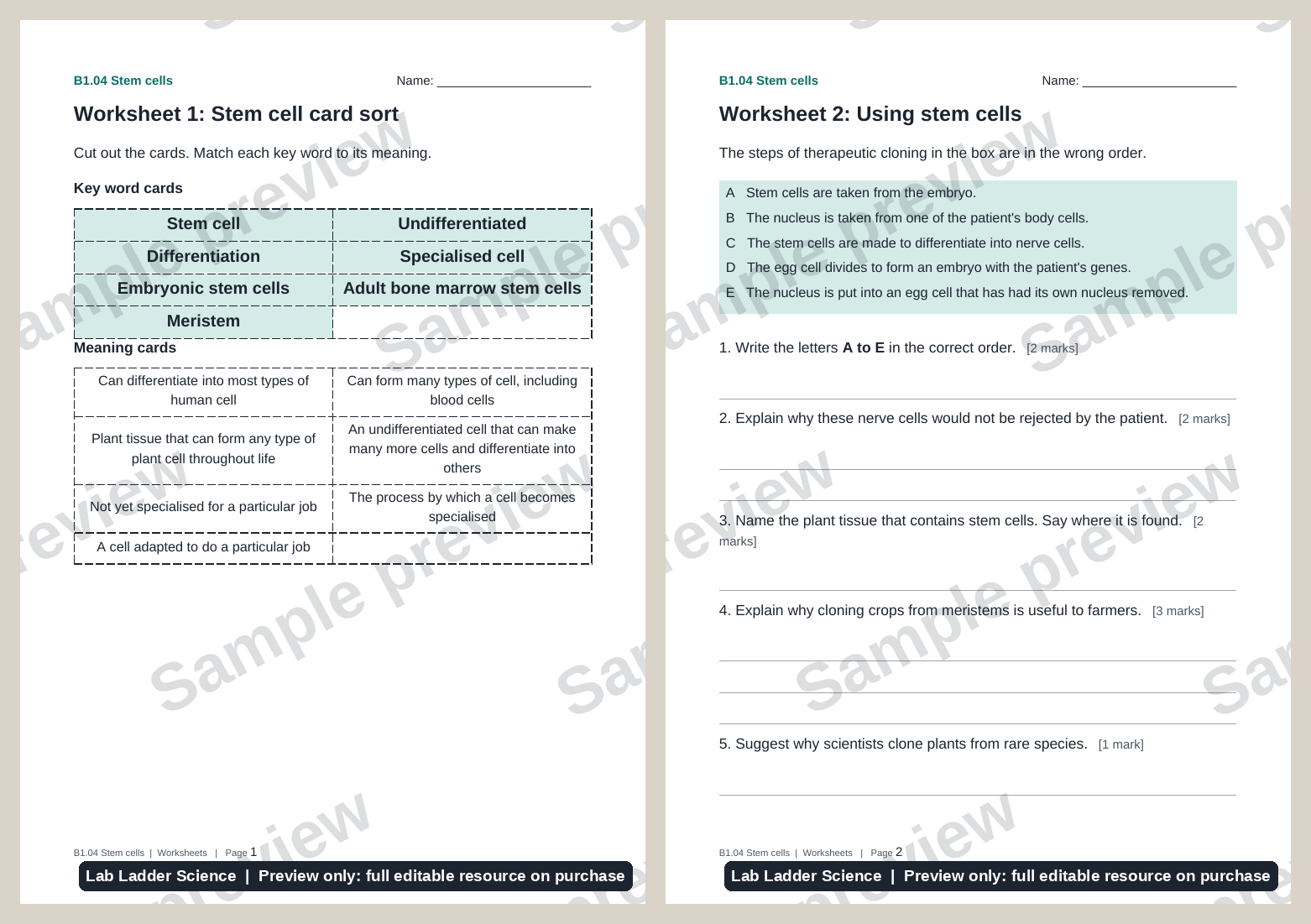
• Editable Word worksheets: a stem cell key words card sort, a therapeutic cloning and meristems worksheet (core and support versions), and an evaluation worksheet with a 6-mark question (core version and a support version with a writing frame).
• Word lesson plan with objectives, lesson sequence, differentiation, mark schemes and common misconceptions.
Lesson outline
• Starter (5 min): What is a stem cell, and why might the body reject cells from another person?
• Activity 1 (15 min): Learn what stem cells are and where they are found, then complete a key words card sort.
• Activity 2 (15 min): Learn how stem cells could be used in medicine, how therapeutic cloning works and how meristems clone plants, then sequence the steps and answer questions.
• Activity 3 (15 min): Weigh up benefits, risks and ethical issues, take part in a role-play debate, then write a 6-mark evaluation.
• Plenary (8 min): Exit ticket at three levels, then self-assessment against the objectives.
Differentiation and inclusion
Every activity offers support and stretch that all students can choose, so no one is singled out. Support includes clue words, hints on every question, a word bank and a writing frame for the 6-mark question. Stretch tasks ask students to compare embryonic and adult stem cells, compare therapeutic cloning with using a patient’s own stem cells, and justify a rule for stem cell research.
The slides follow the British Dyslexia Association Style Guide: a clear sans serif font at a large size, a soft cream background, bold (not italics) for emphasis, left-aligned text and plain English. Levels of challenge never rely on colour alone, every slide has a proper title for screen readers, and diagrams include alt text. Teacher notes give guidance on discussing medical conditions, embryos and religious views sensitively, with ground rules for a respectful debate.
How you could use it
• Teach it as a full lesson on stem cells for Year 9 or Year 10.
• Use it as a ready-made cover lesson: the teacher notes explain every step.
• Use the debate and evaluation worksheet to practise 6-mark extended answers.
• Use the worksheets on their own for homework or revision.
Specification coverage
AQA GCSE Biology 8461, section 4.1.2.3 Stem cells, including the evaluation of practical risks and benefits and of social and ethical issues. Key words: stem cell, undifferentiated, embryonic stem cells, adult stem cells, bone marrow, meristem, therapeutic cloning, rejection, clone, viral infection, ethical issues. The previous lesson in the series is on cell specialisation and differentiation, and the next lesson compares eukaryotic and prokaryotic cells.
You must log in and be a buyer of this download to submit a review.