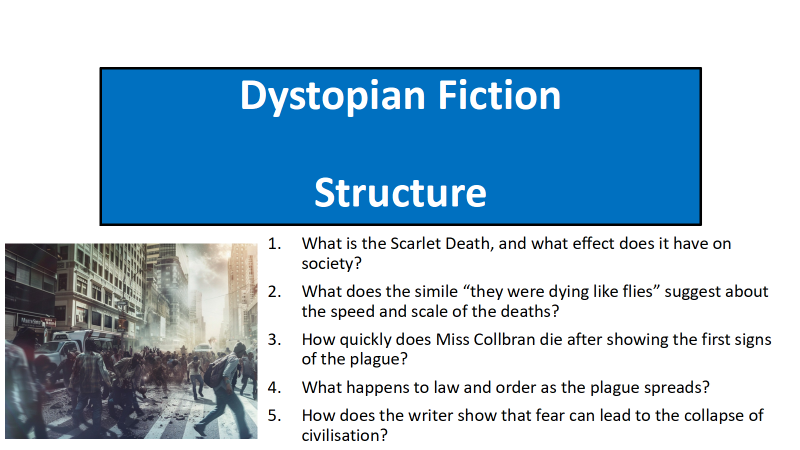
A comprehensive KS3 scheme of work exploring dystopian fiction, with at least 22 lessons examining a wide range of extracts from classic and contemporary dystopian novels. The unit introduces students to a variety of dystopian worlds, from societies controlled by authoritarian governments to futures shaped by technology, environmental catastrophe and the breakdown of civilisation. Through close textual analysis, contextual exploration, discussion and creative writing, students develop their understanding of dystopian conventions and examine how writers use language and structure to communicate ideas and engage readers.
The unit includes one reading assessment focused on language analysis and one creative writing lesson that can be used as an assessment. Although designed for KS3, the resources can also be adapted for KS4.
Texts include:
The Maze Runner by James Dashner, Ready Player One by Ernest Cline, We Yevgeny Zamyatin, The Hunger Games by Suzanne Collins, The Road by Cormac McCarthy, Never Let Me Go by Kazuo Ishiguro, Fahrenheit 451 by Ray Bradbury, The Handmaids Tale by Margaret Atwood, Tender Is The Flesh by Agustina Bazterrica, The Scarlet Plague by Jack London, and The Long Walk by Stephen King.
Students Develop Their Ability To:
Understand and interpret challenging fiction extracts.
Analyse how writers use language to create effects and communicate ideas.
Explore how structure shapes narratives and influences the reader.
Examine characterisation, relationships and character development.
Explain how writers create tension, suspense and atmosphere.
Explore dystopian conventions, including oppressive governments, surveillance, conformity, inequality and resistance.
Analyse how writers present power, control, freedom, survival and human behaviour.
Select and analyse quotations to support interpretations.
Evaluate writers’ choices and their effects on the reader.
Explore relevant social and political context.
Develop analytical paragraphs using textual evidence and detailed explanations.
Discuss interpretations and justify ideas through close reference to the text.
Apply their reading skills to questions inspired by AQA English Language Paper 1, Section A.
Develop descriptive and narrative writing skills through creative writing activities.
What’s Included:
At least 22 ready to teach lessons, with a range of activities and supporting resources designed to develop students’ reading, analytical and creative writing skills.
A range of activities for each extract, supporting comprehension, interpretation and close analysis.
Lessons exploring themes, tension, characterisation, language, structure, evaluation and other key aspects of fiction.
Repeat and retrieval questions linked to previous lessons, helping students consolidate knowledge and revisit important concepts.
Discussion tasks encouraging students to explore different interpretations and support their ideas with evidence.
Annotated quotations, modelling close analysis and exploring writers’ methods.
Model paragraphs demonstrating how to construct effective analytical responses.
Key context lessons to develop students’ understanding of the ideas and concerns explored in dystopian fiction.
A variety of analytical questions inspired by AQA English Language Paper 1, Section A.
Creative writing activities and tasks inspired by dystopian settings, characters and scenarios.
A reading assessment focused on a language question.
A dedicated creative writing lesson that can be used as an assessment.
Reflection and plenary activities to consolidate learning and check understanding.
Due to copyright, some extracts that are not in the public domain have not been included. Links to these extracts can be found in the notes on the first slide.
You must log in and be a buyer of this download to submit a review.